At a glance
This project will create GlassArtEnergy.org, an open… Read full summary
- Funding received
- 2025-2026
- Mini
- Awarded
- $1,916
- Funding partners
-
- Services and Activities Fee (SAF)

This graphic describes the information exchange that is intended by GlassArtEnergy.org. It focuses on two major topics: Fuel Economy and Investment/Interest in Research. Fuel Economy leads to lower energy bills which leads to more sustainable studios. Investment and Interest in Research is described through the conservation of energy and natural resources which leads to glass making for future generations.
The conclusion is simple: Less Gas = More Glass

This photo was taken during my time on the Green Panel at the 2016 Glass Art Society Conference in Corning, NY.
The panel consisted of five members of the glass community who are dedicated to improving energy efficiency in hot glass art studios.
Tootz Zynsky, world-renown glass artist, invited me onto the panel upon hearing about my initiative GlassArtEnergy.org
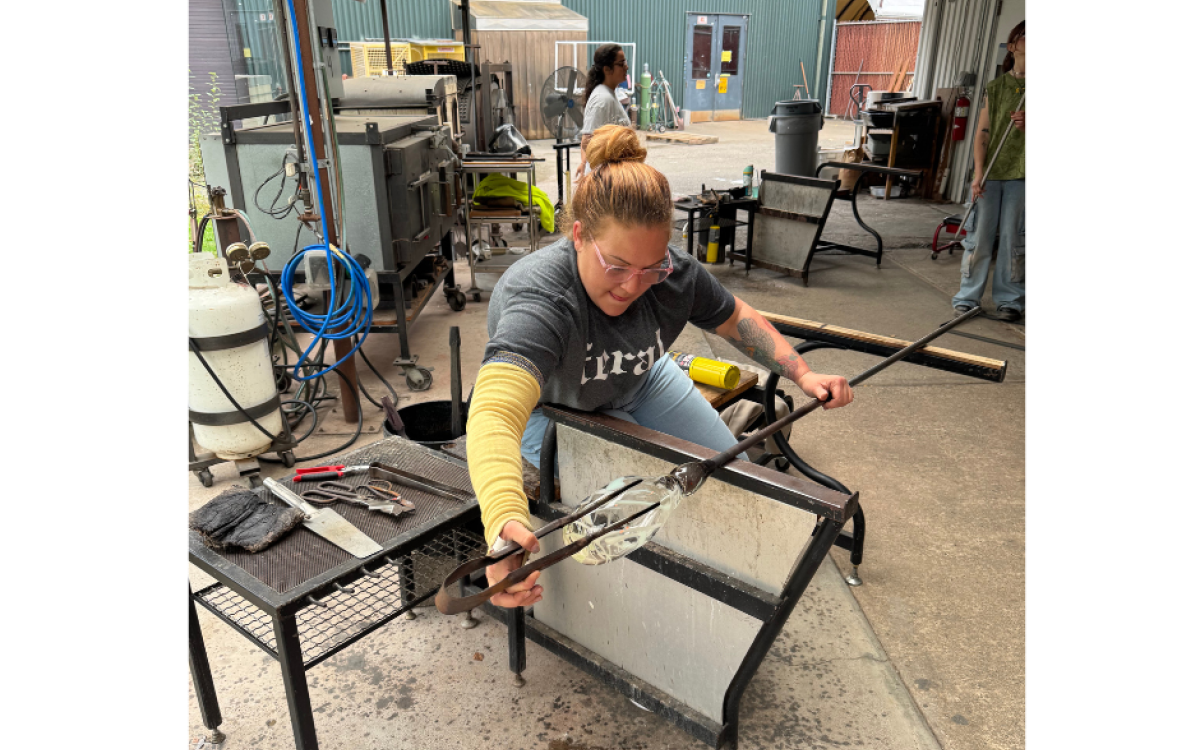
This photo was taken on my first day of my Graduate Program here at the University of Washington in September. I am making a blown glass flower vase.
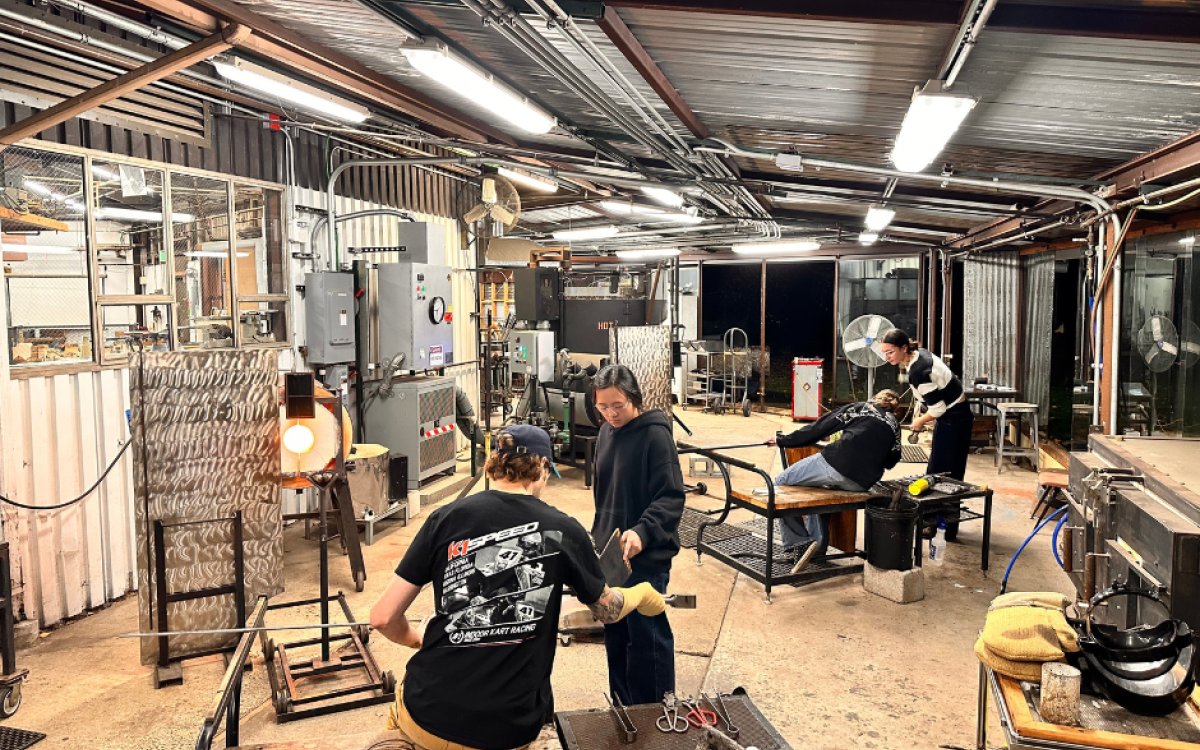
This is a photo of undergraduate students blowing glass in our hot glass studio at the University of Washington. There are typically around 20-30 students who access this shop each quarter.

This photo is of an article from the December 2017 issue of Glass Art Magazine featuring my project Glass Art Energy from my time as an undergraduate in Hawaii. I still believe in this project the same way I did when I started it almost a decade ago.
This project will create GlassArtEnergy.org, an open educational resource focused on improving energy efficiency and sustainability in hot glass art studios. Despite high energy use in glassmaking, accessible guidance and standardized practices remain limited. Building on prior research, the project will develop a centralized website and outreach materials to share sustainable techniques with artists, students, and educators. These resources will be integrated into UW coursework and shared broadly through workshops and digital content. Funding supports website development, a stipend for the project lead, and speaker honorariums.
This proposal aims to seek funding for the creation of GlassArtEnergy.org, an open education resource that will increase awareness about energy efficiency and sustainability efforts in hot glass art studios. Hot glass refers to studios that use furnaces to melt glass at high temperatures for the purpose of creating blown glass art. The University of Washington (UW) has had a hot glass studio since 2001.
Despite growing awareness of sustainability in the arts, there is a lack of standardized practices and accessible technologies to help glass artists reduce their energy footprint without compromising artistic quality.
I started this project in 2016 at the University of Hawaii at Manoa (UHM) through the Undergraduate Research Opportunities Program (UROP). I received two consecutive grants to conduct this research and presented the findings at the Glass Art Society Conferences in Corning NY (2016) and Norfolk, VA (2017). My work received two honorable mentions at the UROP Showcase in 2017 and was published in Manoa Horizons, UHM’s scholarly journal. The project was featured in Glass Art Magazine in December 2017.
Due to a lack of funding, I was forced to put the project aside until now. The need for this educational research is still very evident. It is significant for UW to continue this initiative because of its foothold in the glass art community.
The main goal of the project is to continue my research and establish an accessible website that hosts curated information. The second goal is an outreach initiative to integrate these efficient practices in education here at the UW and abroad. This will consist of digital presentations, newsletters, and other content-based outreach through social media platforms. I will be teaching Art 233 Intro to Glass in the Spring quarter and plan to use these resources in my course to aid in the teaching of new artists and makers.
This funding will support the purchase of the domain, website, and data storage for the next two years. It will also cover honorariums for two non-UW speakers at the seminar open to the public and a stipend for my time and labor establishing the website. This funding will provide a foundation for this initiative and allow for its formation and integration into the glass community at the University of Washington and the glass community at large.
3D4M: Ceramics, Sculpture, and Glass
Skye OBrien
Project lead
- skyeobri@uw.edu
- Affiliation
- Student
- Years
- 2 year(s) remaining at UW
- Affiliated groups
- 3D4M: Ceramics, Sculpture, and Glass
Sean O'Neill
Team member
- soneill3@uw.edu
- Affiliation
- Faculty
- Affiliated groups
- 3D4M: Ceramics, Sculpture, and Glass
Amie McNeel
Team member
- amcneel@uw.edu
- Affiliation
- Faculty
- Affiliated groups
- 3D4M: Ceramics, Sculpture, and Glass,z
Henry Jackson-Spieker
Glass Faculty
- henryjs1@uw.edu
- Affiliation and department
- 3D4M: Ceramics, Sculpture, and Glass
- Stakeholder approval form
Request amount and budget
Plans for financial longevity
The request for funding will cover expenses for the next 2 years during my time at UW. Once established, I will seek additional funding to integrate the website into future Glass classes at UW and around the country through various organizations and non-profit groups. Ideally once the website is established, I will present the initiative at this year’s Glass Art Society Conference in Corning, NY in June 2026 which will allow it to gain traction and visibility in the international glass art community.
The hope is to educate studio users at the University level so that they make take this knowledge and apply it to their studio practice in the future.
The timeline of this project will take place between December 2025 and April 2026. It consists of three phases: Establishment, Outreach, and Implementation.
Phase One is to establish the accessible, user-friendly website titled GlassArtEnergy.org. This process consists of four stages: Gather information, organize the information, content creation, and then the final website design. This will happen immediately once the domain and website have been purchased through the new year with a soft website launch deadline of February 10, 2026.
Phase Two is Outreach which will happen in two stages. Peer review will happen through group discussions and review of the website’s navigation menus and content, etc. This will take place in the month of February through early March. There will then be a hosted outreach seminar open to the public in mid-March which will include presentations from two speakers followed by questions and discussion.
Phase Three is Implementation in which I will incorporate the website and content into my Intro to Glass curriculum in the Spring quarter. The resources will also be made available for the glass community at large to utilize in their studios, classes, and personal practices.
Plans for long-term project management
This project will be established throughout my time in the graduate program at the University of Washington in 3D4M: Ceramics, Sculpture, and Glass. I plan to utilize the computer labs and library resources to aid in the gathering and curating of information for the website. My goal is to create a supplementary educational resource that can be used in Glass courses at UW in the future. These resources will be accessible to anyone in the glass community to use at their studios as well. I will continue this project after my tenure at UW with the hope that it will grow and be spread throughout the international glass community.
Problem statement
Glass art making is an inherently energy-intensive process, involving high-temperature furnaces, kilns, and torches to melt, shape, and cool the glass. While the artistic value of glasswork is undeniable, the environmental and economic costs associated with glass art making presents significant challenges. Traditional hot glass studios often rely on outdated equipment and inefficient heating methods, resulting in excessive energy use, high operational costs, and increased carbon emissions.
Despite growing awareness of sustainability in the arts, there is a lack of standardized practices and accessible technologies to help glass artists reduce their energy footprint without compromising artistic quality. The problem is compounded by limited research on energy-efficient practices and energy alternatives tailored specifically to small-scale or independent glass studios.
This project seeks to address the following core issue:
How can energy efficiency be improved in glass art making through the adoption of sustainable practices, innovative technologies, and optimized studio workflows—while maintaining the integrity and quality of artistic output?
Key challenges include:
- Identifying energy-saving equipment and materials suitable for artistic glasswork
- Reducing heat loss and optimizing furnace/kiln usage
- Educating artists on sustainable studio practices
- Balancing cost-effectiveness with environmental impact
Solving this problem could lead to more sustainable art practices, lower energy bills for artists, and a meaningful contribution to climate-conscious creative industries.
Problem context
Glass Art Energy: The Future of Glass Art Making is a project that exemplifies the sustainability ideals of the University of Washington. UW’s Sustainability Action Plan focuses specifically on the area of energy efficiency, waste reduction, and academic research related to these goals. This project will implement sustainability education in glass art and will be open to the entire campus community and the glass community at large. The goal is to create a community of energy efficient students by engaging and educating them about ways to reduce their energy consumption and utilize waste materials into their art practice.
Measure the impacts
| Impact / goal | Metric(s) of success | UW stakeholders impacted |
|---|---|---|
| GlassArtEnergy.org: An Open Education Resource | Website analytics will measure the amount of traffic the website receives. We will measure success through these methods. Our goal is to engage at least 100 people throughout the glass community. | Undergraduate, Graduate, Alumni, Academic staff, Admin staff |
| Energy Efficient Studio Users | UW Glass Studio hosts around 60 art students a Quarter. Our goal is to educate them on energy efficient studio practices through the website. My Intro to Glass course in the Spring will host 14 students who will directly engage with the project. | Undergraduate, Graduate, Alumni, Academic staff, Admin staff |
| Engaging the Glass Community at Large | The goal is to engage the glass community at large by offering a public, safe space to engage with the information exchange. Our goal is others will offer information and engage in conversation about energy efficiency in glass studios. | Undergraduate, Graduate, Alumni, Academic staff, Admin staff |
Communication tactics and tools
The goal of the project is to create a website that is accessible to anyone who is interested in the topic. We will utilize an array of social media strategies and create a monthly newsletter showcasing different aspects of the site. The newsletter will also communicate contact information so the community can ask questions, provide feedback, and share resources with the site.
Phase Two of the project will consist of organized peer-review sessions and a formal seminar open to the public. The seminar will host a presentation on how to navigate the site for optimal education, feature two speakers well renown in the glass community who are focused on energy efficient practices, and engage the audience in question-and-answer discussions.
Outreach communication plan
I am excited to share this project with the community here at the University of Washington in Seattle. Our goal is to create a user-friendly, open education resource that can be utilized by anyone interested in learning more about hot glass art making. Phase Two of the project is Outreach in which we will host a variety of peer-review sessions that are open to the public as well as a formal seminar showcasing digital presentations, and lectures on the topics.
I believe the art community of UW will directly benefit from this project and hope to create a future of energy efficient glass studio users. The 3D4M: Ceramics, Sculpture, and Glass program will be dramatically impacted through this education, and our hope is to create a sustainable studio environment for years to come.
Student involvement
The art students at the University of Washington will be important for the success of this project. The goal is to provide an engaging educational resource with information they can apply to their practice while studying at the university and then continue to use this education in their professional practice after graduating. During the peer-review process, the average of 60 art students per quarter along with their teaching staff will be asked to review the website voluntarily and provide valuable feedback regarding its development. This project is open for all students, faculty, and staff that are interested in learning more about glass art making, and it is our hope to engage those of the UW community that are studying in areas outside of the arts as well.