At a glance
Project Indoor Farm (Project IF) is a student-led vertical hydroponic farm in Condon Hall that… Read full summary
- Funding received
- 2025-2026
- Large
- Awarded
- $9,179
- Funding partners
-
- Services and Activities Fee (SAF)
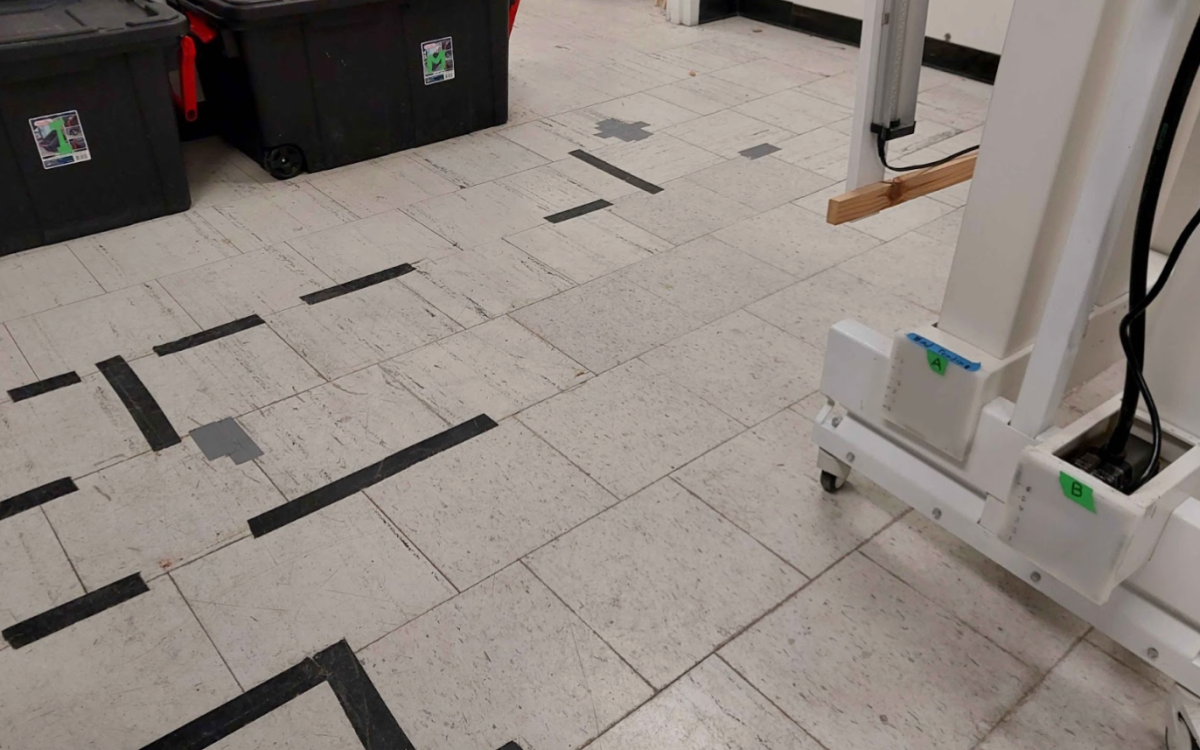
Many floor tiles are taped to prevent tripping hazards and sliding.
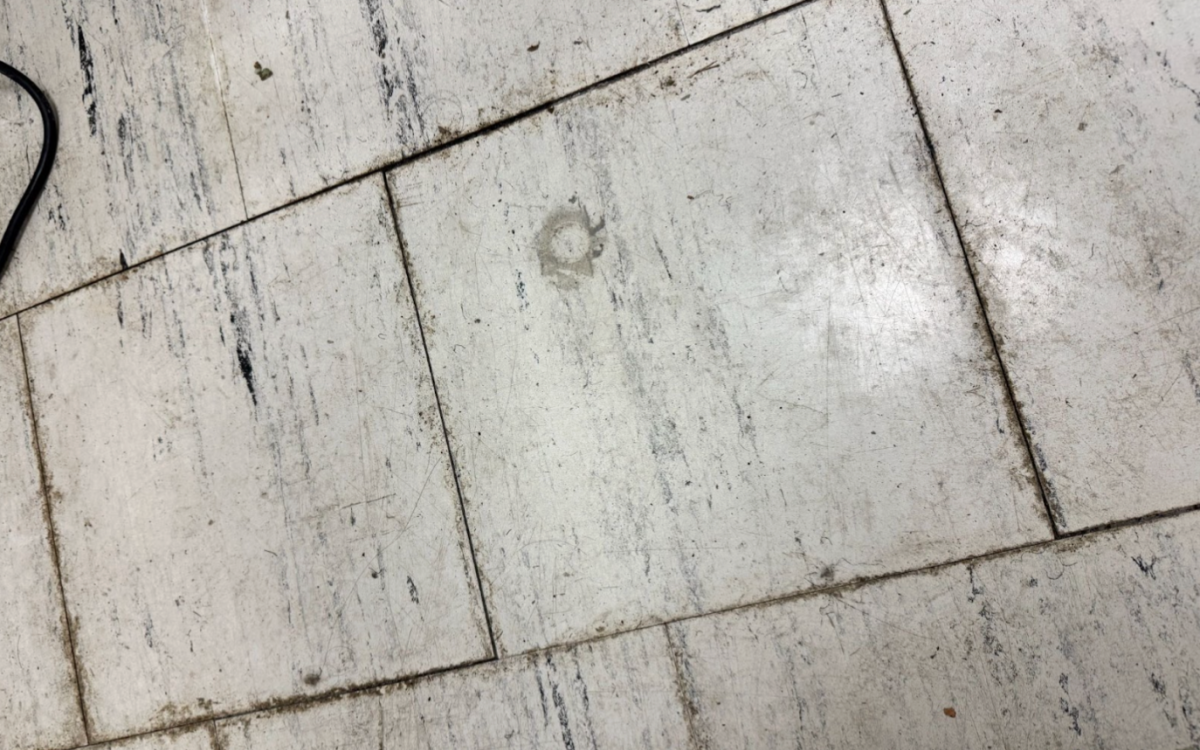
Warping from water damage leaves gaps between untaped tiles that can result in them sliding or rocking when stepped on.
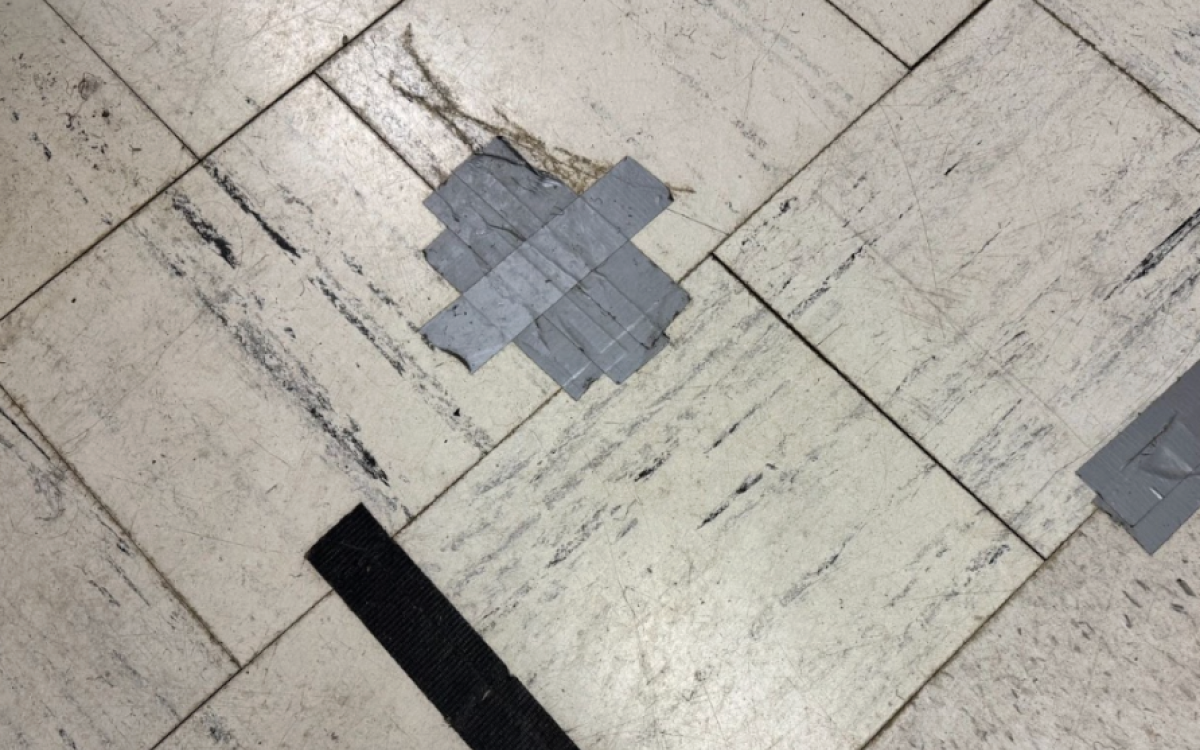
Some tiles have large fragments broken off and taped over.
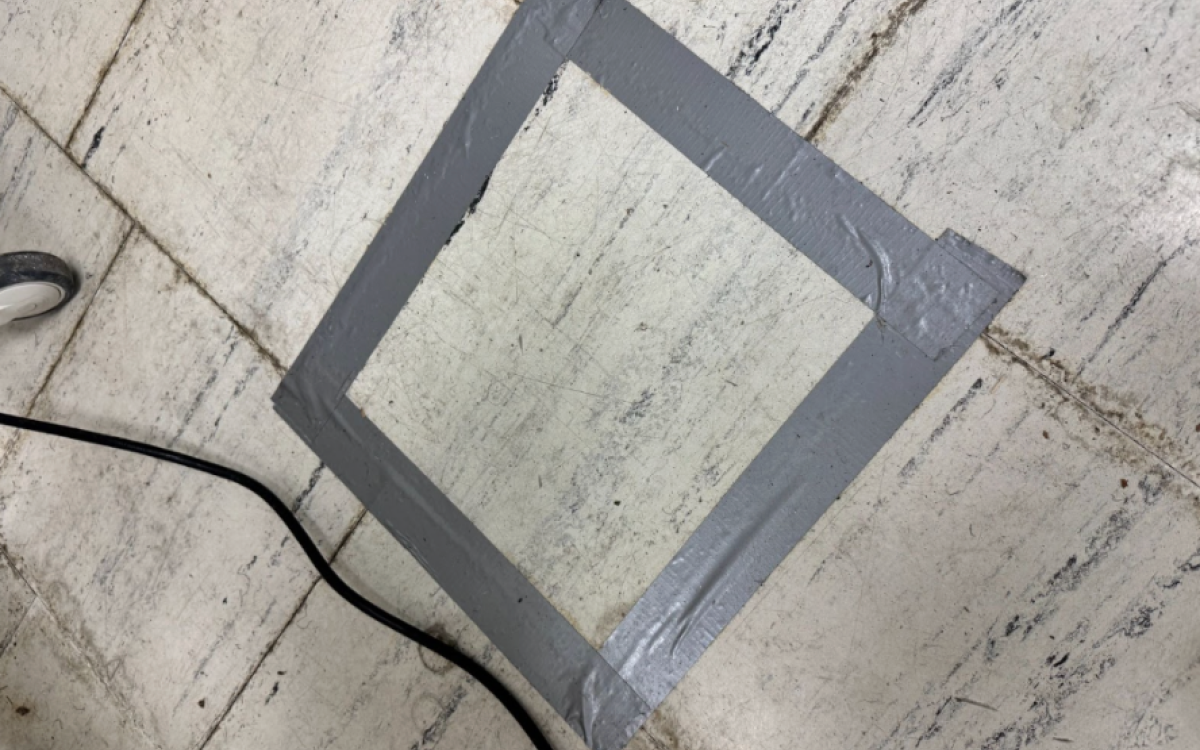
Entire tile is loose and had to be taped down.
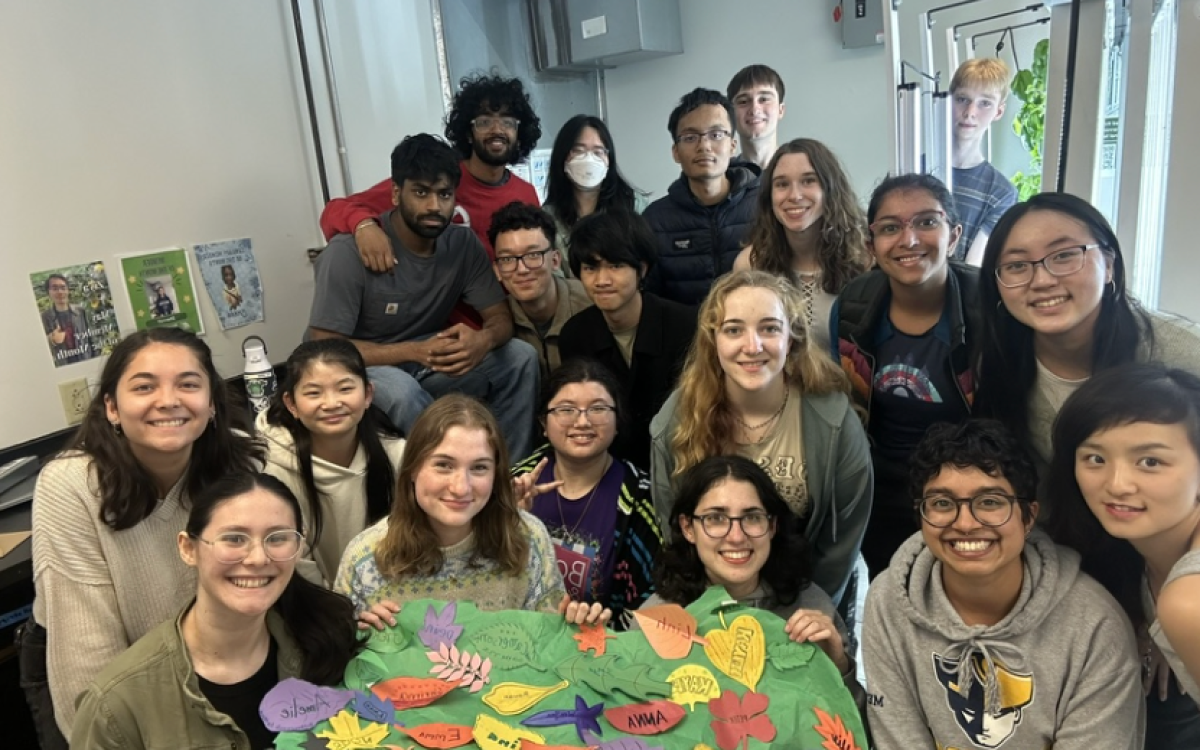
Project IF members gather around a craft project on the farm. The farm builds community and encourages urban farming education, which is why safe flooring is so important for us to continue furthering our mission.
Project Indoor Farm (Project IF) is a student-led vertical hydroponic farm in Condon Hall that provides hands-on opportunities for students to learn about sustainable agriculture, food systems, and climate resilience. Through daily farm operations, interdisciplinary research, and community partnerships, Project IF supports student leadership while advancing innovative approaches to urban and space-efficient food production. The farm also contributes to local food systems by donating crops to the Woodland Park Zoo and collaborates with UW students and researchers on sustainable growing technologies and alternatives to peat-based materials. Project IF serves as a community education hub through tours, workshops, and partnerships with K–12 schools and community organizations. CSF funds support the replacement of severely degraded flooring with durable, waterproof vinyl to address safety hazards caused by prolonged water exposure and improve the farm’s capacity to host students and visitors. This infrastructure investment will help ensure Project IF remains a safe, functional, and long-term space for student learning, research, food production, and community engagement.
Project Indoor Farm (Project IF) is a student-led vertical hydroponic farm located in Condon Hall at the University of Washington. The farm serves as a hands-on learning environment where students engage in sustainable agriculture, applied research, and community-based food systems work. Through daily operations, leadership roles, and interdisciplinary project teams, Project IF equips students with practical skills in sustainability, innovation, and urban farming while contributing to broader efforts to advance food security and climate resilience.
Project IF is requesting $10,000 from the Campus Sustainability Fund to replace the farm’s existing flooring with durable, waterproof vinyl materials. The current flooring is severely degraded from prolonged exposure to water and nutrient solution, resulting in warped, loose tiles that pose ongoing safety hazards. These conditions limit the number of students and visitors who can safely occupy the space and constrain the farm’s ability to operate effectively. Without intervention, the deterioration of the flooring threatens the farm's long-term viability as a safe and functional learning environment.
As the only hydroponics-focused registered student organization on campus, Project IF plays a unique role in introducing students to sustainable, space-efficient agricultural systems. The farm supports a range of student-led initiatives, including automation projects that use computer vision and nutrient distribution systems to improve efficiency, as well as applied research collaborations. Notably, Project IF partners with the Woodland Park Zoo to grow and donate crops for animal consumption, reducing food waste and supporting local food systems. The organization also collaborates with UW TAPPI to develop sustainable alternatives to peat moss growing plugs, addressing the environmental impacts of peat extraction through hands-on, interdisciplinary research.
In addition to research and food production, Project IF serves as a community education hub. The farm hosts tours, workshops, and partnerships with UW students, local K-12 schools, and community organizations to promote awareness of sustainable agriculture and urban food systems. Replacing the flooring will significantly improve safety, increase visitor capacity, and enhance the overall quality of these educational experiences.
The project has been developed in coordination with UW Facilities, Environmental Health & Safety, the Condon Hall Building Coordinator, and faculty advisor Yona Sipos. UW Facilities has provided an estimate for materials and labor, and installation is planned for Summer 2026 to avoid disruption to operations. Project IF has also developed a clear plan for long-term maintenance and continuity. We'll use drainage trays, waterproof mats, and regular cleaning to prevent future damage, and we'll cover the costs through ongoing fundraising. A structured leadership pipeline and documented operating procedures will ensure continued oversight as student leadership transitions over time. While minor funding reductions could be accommodated through limited-scope adjustments, larger cuts would delay the project because partial replacement is infeasible. Full funding is essential to implement a safe, durable, and long-term solution.
With support from the Campus Sustainability Fund, this project will lay the physical foundation for Project IF, supporting continued student learning, research innovation, and community engagement in building more sustainable and resilient food systems.
Angelina Durbin
Project lead
- adurbin4@uw.edu
- Affiliation
- Student
- Years
- 0.5 year(s) remaining at UW
- Affiliated groups
- Project Indoor Farm, UW Department of Environmental and Occupational Health Sciences, Department of Global Health, Food Systems Nutrition and Health Program, UW Food Pantry
Joe Smock
Team member
- jsmock@uw.edu
- Affiliation
- Student
- Years
- 1.5 year(s) remaining at UW
- Affiliated groups
- Project IF, TLC-ART Lab, Department of Pharmaceutics
Abhinav Mukkala
Team member
- mukkabh@uw.edu
- Affiliation
- Student
- Years
- 1.5 year(s) remaining at UW
- Affiliated groups
- Project IF, Electrical and Computer Engineering Department
Raylen Satterwhite
Team member
- rayles2@uw.edu
- Affiliation
- Student
- Years
- 3.5 year(s) remaining at UW
- Affiliated groups
- Society of Women Engineers, Project Indoor Farm
Linh Giakonoski
Team member
- linhg@uw.edu
- Affiliation
- Student
- Years
- 2.5 year(s) remaining at UW
- Affiliated groups
- Project IF, Ethnic Cultural Center, University District Street Medicine RSO, Department of Global Health, Interdisciplinary Honors,
Project Indoor Farm (Project IF) is a vertical hydroponic farm that serves as a hands-on learning environment for students at the University of Washington, fostering a community around sustainability, innovation, and resilient food systems. Operating out of a classroom-sized space in Condon Hall, our student-led farm supports food production, research, and experiential learning opportunities through daily maintenance sessions and collaborative projects. However, the physical infrastructure of our space has become a limiting factor to our operations. The existing flooring in the farm is severely degraded, water-damaged, and unsafe. Loose floor tiles pose persistent tripping hazards, constraining how the space can be used. To continue operating safely in our space and sustain our educational and agricultural initiatives, replacing our current flooring is crucial and time-sensitive.
As the only hydroponics RSO on campus, we play an important role in connecting students to the future of urban, sustainable farming. Compared to an industrial farm, hydroponics is more space-efficient due to its vertical structure and efficient use of water and fertilizer. With factors such as climate change, severe weather, and population growth, the need for sustainable food systems is growing. The necessity of food security and sustainability is more vital than ever. Our goal is to support our community through advancing hydroponics. In addition, we currently have automation projects to speed up farm maintenance, such as installing cameras and pH pumps. To continue pursuing innovative research projects, it is vital that we have a suitable space that does not pose an imminent safety risk to our members.
Project IF partners with the Woodland Park Zoo, donating crops for the zoo’s animals to eat. In every growth cycle, at least one tower on the farm is dedicated to growing crops that the zoo requests for its animals. We then coordinate a date for harvesting and transporting the crops to the Woodland Park Zoo. To prevent contamination of the crops—and therefore maintain their safety—we need to replace our floors. Otherwise, we would not be able to maintain our collaboration with the zoo.
Simultaneously, we have begun a research collaboration with UW TAPPI, the Technical Association of the Pulp & Paper Industry. The research involves developing an alternative to the peat moss plugs we currently use on the farm. The harvest of peat moss for agricultural use causes immense ecological harm, releasing carbon stored in the bog and increasing emissions during transportation. General members from both clubs are encouraged to engage in the research and development process, encouraging greater connection between different groups within UW’s sustainability community. The final product is intended to be a plug that resembles peat moss and is projected to be made from cellulose. This collaboration serves as a point of innovation to improve the sustainability of hydroponic systems, creating a more affordable alternative to peat moss than currently available on the market. For us to properly test this alternative plug, our farm must be in proper working condition, which requires replacing the floors.
Project IF is an entirely student-led organization, and we’ve had to employ a strong club leadership structure to keep our farm operating and growing over the past few years. We have an officer board of 5-7 students to organize general meetings, farm operations, and project teams. We recruit throughout the year to maintain a full officer board and make applications accessible to all general members in the club. Our officer board meets weekly to discuss farm operations, outreach, and budgeting, and holds itself accountable through a horizontal leadership structure. We also have other opportunities for members to get involved through “Lettuce Head” (maintenance lead) and project leadership positions, which are open for application on a rolling basis.
Project IF has maintained communication with appropriate departments throughout this project. We have been in communication with the Condon Hall Building Coordinator, Elaine Tobin, UW Facilities, UW Environmental Health & Safety, and our Faculty Advisor, Yona Sipos, to receive approval for this project. Project IF has already secured an estimate from UW Facilities to replace our current flooring. Facilities quoted an itemized sum of $8,654 to cover all labor, materials, and other costs associated with removing the current flooring and installing vinyl floors. Implementation of the budget will be prompt, as Facilities estimates 18 total hours of labor are needed. We propose that the flooring replacement should take place during the summer of 2026, when no Project IF operations will be underway in the space.
The implementation of the project will be overseen by the officer board, with direct advice from administration, while construction will be entrusted to the UW Facilities team. As a board, we have experience with project management to ensure that this project runs smoothly and successfully. Furthermore, this project is a one-time operation, and if undertaken, the floors will not need replacement for the foreseeable future. On the other hand, if not funded, our floors will continue to deteriorate, rendering the farm completely unsustainable for future use. We need a safe, well-constructed space to provide students with hands-on education, research, and community-building opportunities in food systems and sustainability. If funded by the Campus Sustainability Fund, a vinyl flooring replacement would eliminate physical hazards from our space and allow students and community members to continue learning about and participating in innovative research on the farm.
Elaine Tobin
Condon Hall Community Manager
- elaint9@uw.edu
- Affiliation and department
- UW Staff
- Stakeholder approval form
Michelle Trudeau
project IF Fiscal Administrator
- michtru@uw.edu
- Affiliation and department
- Faculty, School of Public Health
- Stakeholder approval form
Meagan Gourley
Facilities Support
- gourley@uw.edu
- Affiliation and department
- UW Environmental Health and Safety
- Stakeholder approval form
Request amount and budget
UW Facilities visited our space in December 2025 and provided an estimate of $8654 to replace the current flooring with new vinyl. The cost breakdown of this replacement, as provided by UW Facilities, is as follows:
| Phase - Trade | Hours | Contract | Equipment | Materials | Labor | Shop Total |
| Flooring | 18 | $0 | $0 | $2,150 | $2,225 | $4,375 |
| Haz. mat | 0 | $4,279 | $0 | $0 | $0 | $4,279 |
| Totals | 18 | $4,279 | $0 | $2,150 | $2,225 | $8,654 |
As recommended by UW EH&S, we are requesting an additional $1,346 to cover the rising cost of materials between now and Summer 2026, as well as the entryway space that was not included in the original estimate (4 feet by 4 feet). This increases our total ask to $10,000.
How the project will react to funding reductions
Project IF recognizes the importance of equitable funding distribution and has considered how different levels of budget reductions would impact the scope and timeline of our project.
With a 10% reduction in funding, we would still be able to proceed with a full replacement of the primary operational flooring within the farm during Summer 2026. However, we would scale back the project by excluding the entryway area. While upgrading the entry space would improve the overall appearance and visitor experience, it is not critical to farm operations or safety. This adjustment would allow us to prioritize high-impact areas where water exposure and safety risks are greatest, ensuring the farm's core functionality is preserved.
With a 20% reduction in funding, completing a full flooring replacement would no longer be feasible within the proposed timeline. Based on guidance from UW Environmental Health & Safety, partial replacement is not a viable long-term solution, as it would lead to uneven wear, continued water damage in untreated areas, and the need for additional repairs in the near future. Instead, we would delay implementation until Summer 2027 and pursue supplemental funding through additional grants, departmental support, and expanded fundraising efforts. While this would allow us to eventually complete the project as intended, it would require continued operation in a compromised space, limiting our ability to safely host visitors and fully utilize the farm.
With a 50% reduction in funding, the project would be significantly delayed and dependent on securing substantial external funding before moving forward. At this level, we would not initiate any partial installation due to the long-term inefficiency and increased costs associated with incomplete replacement. Instead, we would focus on short-term mitigation strategies such as reinforcing existing tiles, increasing the use of protective mats, and further restricting capacity in the space to manage safety risks while actively seeking additional funding sources. However, these measures are temporary and do not address the underlying infrastructure issue.
Overall, while minor reductions can be accommodated through scope adjustments, larger funding cuts would delay implementation and reduce the project's immediate impact. Full funding is critical to ensuring a safe, durable, and long-term solution that supports Project IF’s operations, educational programming, and community engagement.
Plans for financial longevity
After replacing our current flooring, we'll prioritize keeping the new flooring in excellent condition to avoid future damage. Given the nature of Project IF’s operations, nutrient solution can leak from the towers onto the floors, causing water damage to the vinyl tile. To prevent further water damage, we are currently using shallow trays to catch water that drips from our towers. This has been an effective intervention thus far, but it does not remove the already existing water damage to our floors that resulted from prior years.
After consulting with the UW Environmental Health and Safety team, we have decided to purchase waterproof mats to place under our towers. These mats will be installed after our flooring replacement to provide an additional safeguard against water damage to the new floors. These mats will be purchased with profits from the three Makers' Fair fundraisers we have participated in this year.
UW Environmental Health & Safety recommends that we regularly mop up any spills on the floor. Because our floors have many loose tiles, they advised against using a mop on them. We have already purchased a mop using our fundraising profits for future cleaning once the flooring is replaced.
These strategies to prevent water damage to our new flooring will ensure we do not have to replace it again in the future.
This project is scheduled to take place between June 2026 and August 2026. Project Indoor Farm is closed over the summer months due to a lack of students on campus. Every June, we spend a week cleaning the farm, disassembling our vertical towers, and storing items for the summer. If approved for funding, we would move all of our supplies into our office space during our cleanup in June. This would allow space for UW Facilities to replace the existing flooring with vinyl tiles. We are in regular communication with UW Environmental Health and Safety and UW Facilities, who have both assured us that a flooring replacement can be scheduled for the summer. In September, the officer board will do a thorough inspection of the space and work to set up our towers before beginning operations for the Autumn quarter 2026.
Plans for long-term project management
The members of the Project IF Officer Board who will be primarily responsible for coordinating this project are Angelina Durbin (co-President), Joe Smock (co-President), and Ishaan Verma (Farm Manager). Angelina will graduate in spring 2026. She plans to support the grant-writing and project-planning process until her graduation. After her graduation, Joe will become the sole President of Project IF, assuming its administrative responsibilities. Joe graduates in the spring of 2027, which means he will be at UW throughout the project’s proposed timeline. Additionally, Ishaan will assist Joe with the project's administrative responsibilities as Farm Manager. Ishaan graduates in the spring of 2028, meaning he will also be a student at UW throughout the project’s timeline.
To ensure that future officers of Project IF understand how to prevent water damage to the new flooring, we will write a section on water damage prevention strategies into our operating plan. Our operating plan is reviewed by our operations team once a quarter, ensuring that club officers understand the importance of preventing water damage to the new flooring.
Problem statement
Project IF educates members of the UW community about sustainability, food systems, and hydroponic farming. The organization provides a space for students interested in sustainability to work together and discuss both the operational logistics of a hydroponic farm and the broader role of hydroponics in urban food systems. Additionally, Project IF enables students to practice working with hydroponic systems by experimenting with new technologies, techniques, and crops in its 32 vertical towers. All of these opportunities are made possible by the RSO’s Condon Hall space, which houses its hydroponic systems, educational materials, engineering projects, and other supplementary resources.
The space in Condon Hall currently has many loose and warped floor tiles that pose a hazard to Project IF’s operations. Although the space is designed with drainage in the floor, water damage has accumulated over the farm’s lifespan, weakening the floor’s integrity. Several tiles are completely detached from their foundations, causing them to slide when stepped on. Gaps between tiles create an uneven floor surface and worsen the sliding issue. Tiles may also be warped upward at their edges, rock when stepped on, or protrude above the floor plane. Some tiles are missing fragments that broke off due to water damage. These conditions create tripping hazards for RSO members and visitors, limit the farm's accessibility, and make floor sanitizing difficult by exposing the underlying concrete foundation beneath the tiles.
To mitigate these issues, the Project IF operations team has taped over warped or sliding tiles and missing fragments. While this has limited the major risks, tile movement and surface unevenness cannot be fully resolved, and the presence of tape on the floor introduces its own accessibility hazards. A like-for-like replacement of the floor tiles would represent a more permanent and safe solution to the flooring issue. This would ensure that Project IF can continue operating to support sustainability at UW without major safety concerns as it navigates within the organization.
Project IF will preserve the integrity of the replaced floor to ensure it is a sustainable, long-term solution. Per UW Environmental Health & Safety recommendations, the operations team will install waterproof mats under the vertical towers and the seedling ebb-and-flow system to prevent water damage from accidental spills. Additionally, the organization has purchased a mop to immediately mitigate any spills as soon as they occur. We've limited this option because of the current floors. Environmental Health & Safety advised against excessive mopping that applies force to the tiles and may worsen their condition. With the replacement of the tiles, Project IF believes it can maintain safe conditions in the farm space that will be sustainable without future replacement.
Problem context
The flooring replacement will help ensure Project IF’s operations continue in a safe environment. Project IF’s aspiration to grow education and community in the field of sustainable farming is fulfilled primarily by providing access to our farm premises for all UW students to gather and contribute directly on a daily basis.
Project IF is the only hydroponics-focused RSO at the University of Washington, providing directly accessible, hands-on hydroponics experience and education. Working with professional-grade hydroponics equipment positions Project IF as a welcoming space to build a strong, skilled community focused on sustainability and innovation. This relies heavily on our wet-lab space in Condon Hall being maintained to a high safety standard.
Due to the floor condition in our space, Project IF will need to take precautions that significantly limit the freedom and accessibility of our current daily maintenance sessions to ensure safety for groups of members gathering on the farm.
Measure the impacts
| Impact / goal | Metric(s) of success | UW stakeholders impacted |
|---|---|---|
| Accessibility | 40 club members not facing tripping hazard. | Undergraduate |
| Health and Safety | Zero UW Environmental Health & Safety violations. | Undergraduate |
| Sustainability | Zero future flooring replacements | Undergraduate |
Education and outreach goals
Our farm serves as a living learning environment for UW students, K–12 students, and community members. To continue hosting visitors and educating the public about sustainable agriculture and urban farming, we must maintain a safe, functional, and welcoming space. The current condition of our flooring is a critical barrier to achieving these goals. Warped and loose tiles not only present safety hazards but also detract from the overall learning experience. Visitors may perceive the farm as poorly maintained, which can discourage engagement and limit the effectiveness of our educational programming.
Installing new, durable flooring will significantly enhance both the safety and accessibility of our space. It will allow us to host more visitors at once, as we will no longer need to restrict group sizes to prevent damage to the floor. This improvement helps us deliver more hands-on educational experiences, including guided tours, workshops, and classroom visits.
Our outreach strategy focuses on both campus engagement and broader community connections. On campus, we will publicize our events and opportunities through student organization newsletters, social media platforms, email newsletters, and partnerships with academic departments, such as the College of Engineering and the School of Public Health. We will also collaborate with other Registered Student Organizations and campus initiatives to host joint workshops and events, increasing visibility and interdisciplinary engagement.
Beyond campus, we will continue to partner with local schools and community organizations to bring students into the farm for experiential learning opportunities. These visits introduce participants to hydroponic farming, resource-efficient food production, and the role of urban agriculture in addressing food insecurity and climate change. Improving our flooring will allow us to expand these partnerships and host more frequent, larger-group visits.
Ultimately, investing in the physical infrastructure of our farm is an investment in our ability to educate and engage. By improving the foundation of our space, we can expand our outreach, deepen our educational impact, and create a more inclusive and inspiring environment for all who visit.
Student involvement
Project IF’s farm is entirely student-run, with officers and general members running maintenance for the farm six days a week. General members build the skills to ensure a productive growing cycle every quarter. As general members get further involved, taking part in different stages of the growing cycle, they can apply for a maintenance leadership role as a “Lettuce Head.” From there, officer positions are available, covering farm maintenance, education and outreach, grant writing, and project group coordination.
Another means by which general members of Project IF can gain a leadership position is by creating project groups. A project group is created when a general member identifies some aspect of the farm to be improved. After submitting their proposal, the group is created and draws project group members from among the RSO's general membership. The original submitter of the proposal is the project group lead, who works with either the Automation Project Lead or the Sustainability Project Lead. Currently, there are five ongoing project groups.
The first two groups are part of the farm automation efforts, including the Computer Vision and Nutrient Distribution projects. The computer vision project uses high-level machine learning algorithms to estimate plant volume with a stereoscopic camera setup, allowing for a greater understanding of plant growth patterns and enabling further research opportunities on the farm. The nutrient distribution project focuses on automating processes on the farm to allow for continued operation during quarter breaks and to enable a wider variety of plants to be grown.
The third group communicates with the Woodland Park Zoo to arrange the cultivation and donation of crops for animal consumption. This partnership reduces the food waste that Project IF had previously generated, as the farm would produce more crops than general members could consume within a safe timeframe. It also provides nutritious crops to the animals at the Woodland Park Zoo free of charge. Through this project group, students can participate in the local food system.
The fourth group is focused on developing a website for Project IF. This project will enable greater community outreach, spreading the word about the RSO and the opportunities we provide. It also allows students to apply the web design and coding knowledge they gain in their classes to the RSO.
The final group focuses on a research collaboration with UW TAPPI, the Technical Association of the Pulp & Paper Industry. The research involves developing an alternative to the peat moss plugs we use on the farm. 12 general members from both UW TAPPI and Project IF are currently engaged in reviewing published research relating to peat moss and plug creation, manufacturing prototypes out of molds fitted to Project IF’s set-up, securing materials from on-campus sources that have leftover wood, and eventually testing the resulting plugs to see how well they perform compared to standard peat moss plugs. This provides an opportunity for students to conduct original research that will directly impact the farm’s operations. It also acts as another way for Project IF to engage with the larger sustainability community at UW.