At a glance
This project supports the Wapato Pond and Native Garden at the UW Farm, which provides Åmerican Indian/Alaska Native (or “… Read full summary
- Funding received
- 2025-2026
- Mini
- Awarded
- $2,702
- Funding partners
-
- Services and Activities Fee (SAF)
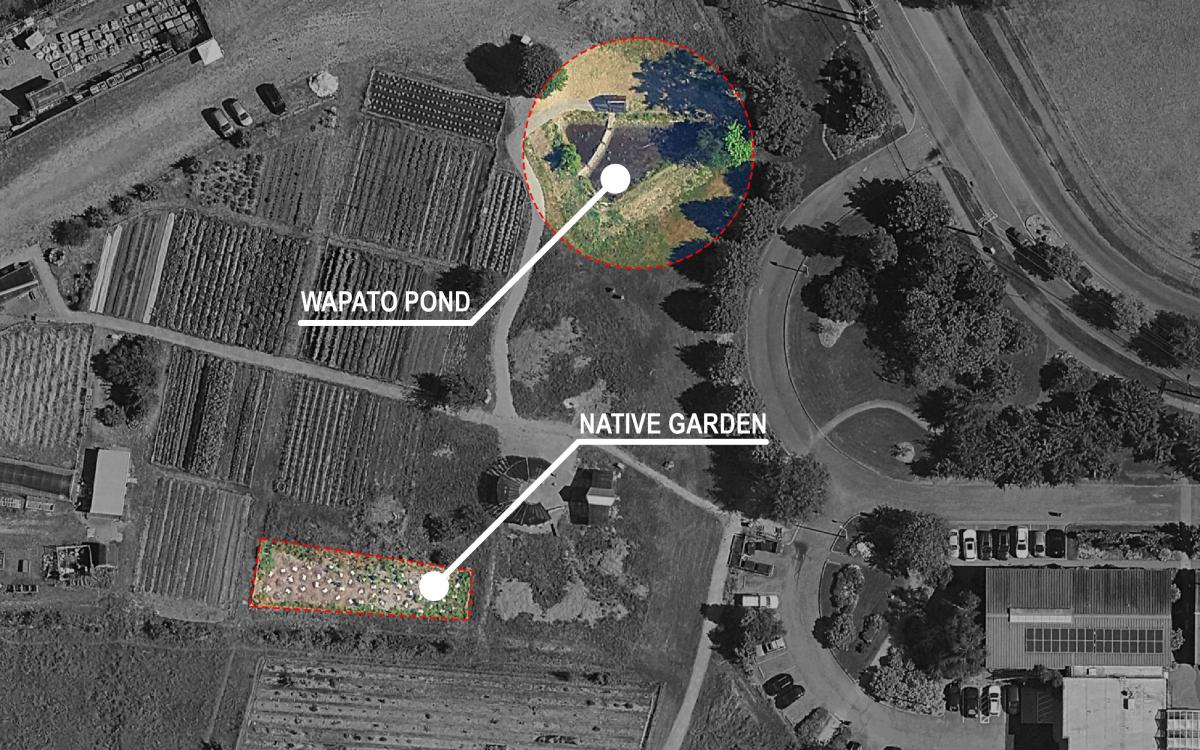
An aerial image of both project sites (Native Garden and Wapato Pond). Both these sites are a part of the newly dubbed "Native Food Ecosystem" that is stewarded by the Burke Meadow team.
This project supports the Wapato Pond and Native Garden at the UW Farm, which provides Åmerican Indian/Alaska Native (or “Native”) students, faculty, and staff with access to traditional foods, medicines, and hands-on opportunities to practice land-based culture and environmental stewardship. Originally funded to address food insecurity and cultural disconnection, the project maintains and enhances these spaces through Native-led planting, irrigation, and stewardship, ensuring they continue to serve as living sites of Indigenous knowledge, education, and community care.
The Wapato Pond and Native Garden are two plots of land located at the UW Farm. These sites aim to address multiple challenges that the UW Åmerican Indian/Alaska Native (or, “Native”) community face on campus: food insecurity, a lack of accessible opportunities to practice land-based culture, and culturally-informed environmental stewardship. Much of the equipment that keeps the Native Garden and Wapato Pond running is secondhand equipment from the UW Farm. In addition to the used condition of the equipment, there has been a lack of funding to replace this equipment. In order to effectively and efficiently steward these spaces, we are applying for funding through CSF to replace maintenance tools, upgrade irrigation systems, and bolster Native planting throughout each site.
Firstly, the Intellectual House (IH) created the Native Garden in 2019 using CSF funding to combat food insecurity that Native students faced while attending the UW. Since 2019, the IH has onboarded successive Food Sovereignty Liaisons (FSL). Each of these FSLs, noticing shifts in Native student wants and needs, prioritized different Native plants that would feed Native students culturally, spiritually, and nutritionally. Our tarps, irrigation system, and perimeter fence are all in poor shape. Repairing this equipment would allow future cohorts of Native students and FSLs to better steward the space and produce plant foods and medicines.
Secondly, since the creation of the Wapato Pond in 2024, stewardship responsibilities have shifted away from the UW Farm and have been bundled with the Native Garden. This pond offers immense cultural, educational, and traditional food opportunities. As the name implies, wapato, or duck potato, is grown within the pond, which is also a traditional food eaten by the first peoples of this land. As colonization progressed, this food was less prioritized and the surrounding food culture found less prevalently. CSF funding could continue to help proliferate and expand Wapato Pond plantings to protect the pond’s perimeter and to promote natural filtration of the waters coming in and out of the pond. These expansions and protections will ensure a more stable continued passing of cultural knowledge and food practices.
Eric Alipio
Project lead
- ealipio@uw.edu
- Affiliation
- Student
- Years
- 2 years year(s) remaining at UW
- Affiliated groups
- Burke Meadow Team
Theo Wright
Team member
- ysw16@uw.edu
- Affiliation
- Student
- Years
- 1 year year(s) remaining at UW
- Affiliated groups
- First Nations @ UW; Intellectual House
Polly Olsen
Administrative Lead
- polly@uw.edu
- Affiliation and department
- Burke Museum of Natural History and Culture; Burke MEadow Team
Request amount and budget
Plans for financial longevity
As the Native Food Ecosystem becomes more interdepartmental and spans the student-faculty-staff strata, it is expected that the coordinated effort will result in better maintained equipment and more closely stewarded sites. Because of leadership change within the Intellectual House over the past two years, the Native Garden fell into disrepair and much of its equipment left untended. However, since the partnership between the Burke Meadow team and Intellectual House, there has been a surge of support for all three sites – Burke Meadow, Native Garden, and Wapato Pond. Not only is each site better tended with well-attended workparties and more frequent workparties, the administrative infrastructure for each site is better managed. For example, each site is actively working towards developing maintenance plans that are culturally informed and are expected to be regularly updated by student partners. Documents such as this have already begun to be organized within a centralized and accessible digital repository within the Burke Museum.
Because of this renewed attention to detail and larger student-faculty team, it is expected that the agricultural equipment we are funding for will last another six to ten years. The plants we are anticipating to grow at the Wapato Pond will have a documented maintenance plan that assures proper care and harvest, which will hopefully stave off any future costs for new seeds and starts.
Summary
For most items, funds would be used as soon as possible after awarding. Plant acquisition would occur over time and, with it, the spending of its respective budgeted funds. With a targeted early Spring Quarter planting, this CSF award would be estimated to be completely utilized by April 2026.
Irrigation and Fencing
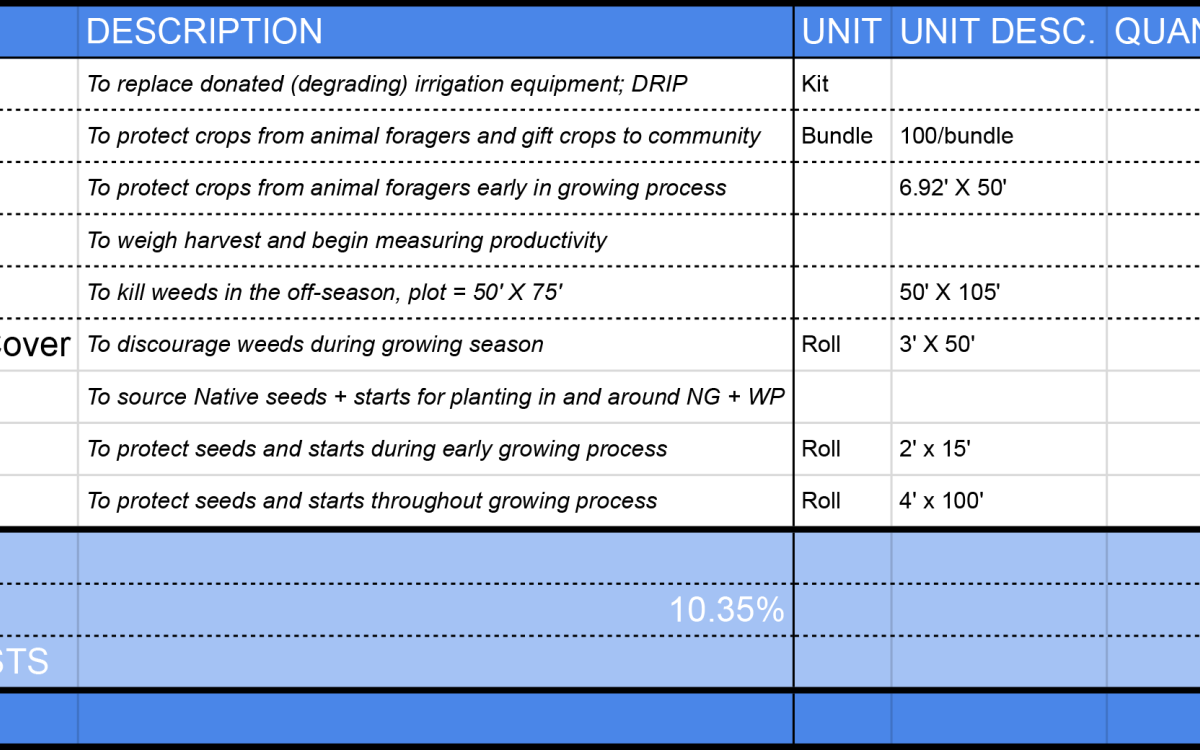
If awarded funds through the CSF Mini Grant, funds would be immediately used to purchase irrigation equipment that would be installed through Winter Quarter. It is important that the newly acquired irrigation system be installed before the 2026 growing season (roughly during Spring and Summer Quarters). Similarly, it is important that fencing be erected to protect plants throughout the growing season, so installation would occur as soon as possible.
Other Agricultural Equipment
If awarded funds through the CSF Mini Grant, funds would be immediately used to purchase agricultural equipment, such as silage tarps, row cover, and burlap sacks, that would help protect plants and suppress weeds throughout the growing season. In addition to protecting the plants during growing, the burlap sacks will also be used to bundle grown foods for gifting to community members.
Plant Sourcing and Planting
If awarded funds through the CSF Mini Grant, funds would be used over time to secure Native plants from various local nurseries. Because of the seasonality of plant growing and nursery inventory availability, it may be that funds be used now as a down payment for plants obtained in hand closer to Spring Quarter or the respective budget be spent fully closer to an early Spring planting. Planting would ideally occur in early Spring Quarter.
Plans for long-term project management
The Native Garden has been managed by student staff since its creation in 2019. Employed by the wǝɫǝbʔaltxʷ Intellectual House, these students take on the position of Food Sovereignty Liaison and subsequently learn time management, event organization, collaboration, and communication across a variety of platforms– not to mention taking on the physical labor of weeding, planting, harvesting, and more. The Native Garden cultivates not just traditional food but also leadership skills that the Food Sovereignty Liaison will carry with them into their careers and community post-graduation.
This NFE is professionally guided by the Burke Museum of Natural History and Culture; the Department of American Indian Studies; the Center for American Indian and Indigenous Studies; the Intellectual House; the College of Built Environment; UW Grounds; the Burke Herbarium; and the UW Farm. Graduate and undergraduate students from a diverse range of colleges within UW provide the base for project visioning and maintenance work performed at the NFE. With these strong networks of partnerships across the University, the Native Garden and Wapato Pond are well situated to continue maintaining and sustaining projects rooted in Traditional Ecological Knowledges (TEK) that nurture students, staff, faculty, community, and the lands and waters.
Problem statement
Since first contact with non-Native settlers of this region, Indigenous communities have been forced to assimilate to Western ways of being. Over time, the connection Indigenous people have had with their respective cultures has been weakened by this assimilation – the first peoples of this land were either unable to practice their culture because of forced relocation or forbidden by colonial orders. Though still existing in various pockets of different Indigenous communities, cultural practices concerning food, art, environmental stewardship, self-governance, and spirituality, to name a few, have become less prevalent throughout each of our communities.
Today, this lack of opportunity for cultural connection within UW’s Native student population still persists. Many Native students, faculty, and staff are eagerly working to make known Indigenous Traditional Ecological Knowledges in a variety of fields. However, with so many cultural practices tied to the land, it is imperative that these cultural teachers and students have access to spaces in which they can reconnect with the land through traditional agriculture, environmental stewardship, and community gatherings. The Burke Museum and Intellectual House are two integral partners to this work as they guide us Native students in stewarding space intentionally and with cultural respect.
Problem context
The Burke Museum of Natural History and Culture has partnered with the Intellectual House (as well as various colleges within UW) to reconnect Native students, faculty, and staff back to the lands and waters that the UW sits on. Through this initiative – the newly dubbed Native Food Ecosystem program – the Burke Meadow Team and Intellectual House co-steward several sites across campus including the Burke Meadow, Native Garden, and Wapato Pond. The Burke Meadow focuses on restoring a camas prairie under the guidance of Indigenous cultural keepers and acts as the homebase for the NFE. We hope that soon we can harvest this first food and prepare these future harvests for Native students across campus. The Native Garden works to provide Native foods and medicines from across the continent, which offers many Native students the opportunity to reconnect with their homelands. Similar to the Burke Meadow, the Wapato Pond was designed to host a first food and its plant relatives which can be used both as food and materials for crafting art and material culture.
Our proposal to renew deteriorating agricultural equipment and seed stock at the Native Garden and Wapato Pond is directly inline with the current NFE objectives of proliferating Indigenous food knowledge and culture; create opportunities for Native community to practice land-based culture; and spiritually, culturally, and nutritionally nourish Native students on campus.
Measure the impacts
| Impact / goal | Metric(s) of success | UW stakeholders impacted |
|---|---|---|
| Proliferate Indigenous food knowledge and culture | - establish formalized signage of ongoing Indigenous food practices at both sites | Undergraduate, Graduate, Alumni, Academic staff, Admin staff |
| Create opportunity for Indigenous community to practice land-based culture | - host at least 1 quarterly event (planting, harvest, weeding, weaving, etc.) using materials grown on site | Undergraduate, Graduate, Alumni, Academic staff, Admin staff |
| Spiritually, culturally, and nutritionally nourish Indigenous students on campus | - ensure all harvested food grown on each site is gifted to Native students, faculty, staff, and broader community members | Undergraduate, Graduate, Alumni, Academic staff, Admin staff |
Communication tactics and tools
As mentioned above, our team regularly records and reports on our processes, progress, insights, and harvest. The Native Garden manages their own Instagram page, which is used to recruit new student participants, share progress of the growing process, and inform students about the work we are performing. The Burke Meadow contributes to the Burke Museum’s Instagram page and uses the platform more broadly as an educational tool for those interested communities off-campus. Additionally, as we hope to educate ourselves and non-Native communities about our cultural practices, we have invited the UW news media to cover the Traditional Ecological Knowledge we have put into practice, most notably the Meadow burn in Winter 2024. However, we, students, have also paneled about and presented our NFE work at various academic conferences, local government programming, and within classrooms as guest speakers. Most importantly, we are actively out in community and personally inviting community members across Seattle to share in our work and learn with us. Through this, at the Meadow, Garden, and Pond, we have hosted workparties and harvests consisting of community members working for Native non-profits, tribal government, and Native small businesses.
Outreach communication plan
One of our major goals for the NFE project is to proliferate Indigenous food knowledge and culture. So, we regularly find opportunities to document our process, our progress, our insights, and our harvest. This documentation comes in the form of social media posts, invitations to UW news media, presentations at various academic conferences, and, most importantly, community gatherings.
Without continually reporting out our progress and sharing our harvest, we risk continuing the cycle of disconnecting Native students from on-campus cultural opportunities. It is integral that we offer stewardship opportunity and harvest with RSOs like First Nations @ UW and Yehawli; that we learn with academic communities like the AIS department and CAIIS; and that we share our knowledge with RSOs like SER.
Student involvement
Because of the interdisciplinary and interdepartmental nature of this project, we, students on the NFE team, are continually exposed to previously unknown fields of study and guidance on the administration of such a large project. With a diverse array of academic backgrounds, such as English, biology, environmental science, American Indian studies, landscape architecture, art history, ecology, and more, we are each equally expected to holistically understand the project using both humanities and STEM lenses. Our advising faculty, also coming from various backgrounds, are great mentors in this regard. So in addition to the student job opportunity we are given by the Burke Museum and Intellectual House, we are also given the opportunity to develop our ability to engage in multidisciplinary research, data analysis, and reporting.
With three sites to steward and a goal to create opportunity for Indigenous community to practice land-based culture, we are continually inviting fellow students, faculty, and staff to join us weeding, planting, harvesting, weaving, cooking, and more at these three sites. These volunteers are imperative to successfully stewarding these sites and accomplishing our mission of proliferating Indigenous food knowledge and culture.