Thinking of applying?

Everything you need to know about the CSF application process from the types of grants offered, eligibility, evaluation criteria, to funding restrictions.
The CSF empowers UW students through various grants and the grantmaking process, providing resources and guidance to lead justice-centered sustainability projects. These grants enable students to build essential skills and drive meaningful change on campus and beyond.

Large: Projects over $5,000 that usually need a longer timeline, strong partner engagement, and close collaboration. Large grants require a letter of intent and, if approved, a full proposal. Funding cycles are in fall and winter.
Mini: Projects up to $5,000 that can usually be completed on a shorter timeline. These are open on a rolling basis throughout the year, except summer.
Resilience & Compassion Seed Grant: Projects up to $5,000, co-funded with the Resilience Lab and open to the tri-campus community. Applications open in spring quarter.
Technology & Sustainability: CSF and the Student Technology Fee have a history of co-funding projects. For 2026–2027, STF has awarded CSF $25,000 for technology components, which can be built into any of our grant offerings.
For large and mini-grants we require a meeting with our Grant & Project Coordinator before submitting your application. This will improve your chances of funding by helping you align with the CSF Committee’s priorities.
To explore our past grants navigate to our project portfolio page. You can filter based on type (Large, Mini) or category (Resilience Seed Grant, Student Technology Fee).
Applicants must meet one of the following criteria:
- UW Seattle registered student with a fiscal administrator.
- UW Seattle Registered Student Organization (student groups of five or more may register as an RSO) with a fiscal administrator.
- UW Seattle faculty or staff working with students and with fiscal administrative support. Please note that faculty and staff cannot serve as their own fiscal administrators.
*A “Fiscal Administrator” is an individual at the University who is authorized to manage a Cost Center and Grants in Workday and administer funding. Typically affiliated with specific departments, fiscal administrators can be contacted through your departmental connections. They are required by the CSF to manage the funding allocated for your project.
For RSOs that are having a hard time finding a fiscal admin please reach out and schedule a meeting with our Grant & Project Coordinator so we can brainstorm options.
All projects will be evaluated by the CSF Committee based on how well they address the following*:
1) Sustainable impact:
CSF defines sustainability as rooted in collective well-being and shared knowledge that empowers communities and amplifies voices that are historically silenced. With this in mind, projects must be grounded in the overall sustainability of UW's campus and focus on one or more of the following (note this list is not exhaustive):
- Accessibility
- Campus infrastructure
- Cultural resilience, celebration, education
- Environmental preservation/restoration
- Health & well-being
- Interconnected knowledge systems
- Social Justice
- Examples list:
- Access to safe, affordable transportation & housing
- Biodiversity & healthy ecosystems
- Community care & well-being
- Energy usage & renewable energy
- Health justice & equity
- Regenerative food systems
- Waste management & circular systems
- See our project portfolio for more
- We also welcome projects that reimagine sustainability in ways not fully listed here, especially those that challenge dominant frameworks, celebrate alternate ways of knowing, and center community-defined solutions.
- All projects must center equity and expected impacts (i.e., burdens and benefits) on the UW community.
- While projects do not need to address every sustainability category listed above, the Burke Meadow initiative, which was developed through the Camas Meadows Monitoring [2020] and Cross-Cultural Collaboration at the Burke Meadow [2022], is an example of how sustainability at UW can emerge through the interconnectedness of people, knowledge systems, and ecosystems—advancing biodiversity, education, and equitable community engagement. Learn more by visiting the links above.
2. Leadership & student involvement:
- Project member roles must be clearly outlined and reflected in the proposal and project budget, demonstrating a substantial degree of student leadership or student involvement throughout the application and implementation process.
- Projects submitted by faculty and staff are accepted, however, projects initiated and led by students will be prioritized. If submitted by a non-student please consider the following to increase the strength of application:
- Ratio of funded student positions to non-student positions;
- Involvement of targeted student groups and organizations; and
- Involvement of the broader student body throughout the project’s lifecycle (e.g., volunteer opportunities, capstone projects, studio classes, educational opportunities, etc.).
3. Education, outreach, & behavior change:
- Project must include educational and outreach components that help cultivate an aware and engaged campus community.
- Projects should strive for substantial impacts on the UW Seattle campus, and consider efforts that extend impact to broader communities (i.e., the University District, Seattle, the Pacific Northwest, and beyond).
4. Feasibility & accountability:
- Applicants must demonstrate they hold or can attain the technical knowledge, necessary approvals, and project management skills to complete projects successfully.
- CSF encourages compensating labor for:
- Project management to ensure dedicated personnel and capacity for successful project implementation. This includes funding student time, faculty time (beyond expected work responsibilities), and honorariums for advisorship or consultation.
- Community contributions and collaborations that enrich project feasibility and reach.
- Projects requiring ongoing maintenance or staffing must either include these expenses in the budget or demonstrate other funds with an articulated plan to meet the project’s long-term maintenance and staffing needs.
- For large-scale projects with multiple partners please indicate any contributing funds from other sources.
- In considering projects undertaken by campus departments (whether in close partnership with students or led primarily by staff), CSF prefers to award funds strategically, investing in one-time transformational interventions in a campus operation, rather than funding routine operations or planned near-term innovations. Preference will be given to projects that demonstrate they are not likely to be undertaken in the near future without the catalyst of CSF funding, and offer long-term plans to ensure financial and operational sustainability.
5. Budget:
- The project must present a well-researched and feasible budget that effectively accomplishes tasks and compensates team members appropriately.
- Additionally, it should include a timeline for implementing the budget.
- We require all project teams to use the budget sheet linked in the application.
- The budget sheet should include any other sources of funding you have received or are requesting.
*Please note that certain special grants have additional or slightly different criteria, which are detailed in their respective sections below.
Please review this carefully before submitting your budget. The CSF will not approve or allocate funds for the following items:
- Time and labor expended by UW faculty working unless it is outside the scope of regular faculty duties.
- Purchase of gift cards or other forms of compensation to research subjects. While we encourage compensating research subjects for their time, this must come from another funding source.
- Food, drinks, or salable merchandise.
- Research projects unless such projects include an actionable component.
- Project expenses that solely benefit an individual and not the community, group, or project.
- Retroactive funding (i.e., project completion is expected to precede grant award date).
- Items that would be otherwise funded by the University or another funding source.
- Materials with limited use and high environmental burden (e.g., t-shirts, decorations, tote bags, excessive paper advertising materials, etc.). The CSF is open to fund sustainable production and procurement of items that already exist in the consumption cycle (e.g., compostable serviceware, thrifted t-shirts and screen printing, rentable project items, etc.).
- Stipends or salary for work done towards achieving academic credit. This includes work required for graduation requirements (e.g., honors thesis, master's thesis or PhD dissertation).
- Unnecessary travel or gas usage.
Getting your application ready
Below are all the details about each of our grants. Explore information on Getting started, Large grant, Mini-grant, Reselience and compassion seed grant, and Fiscal admin responsibilities. CSF requires a meeting with our Grant & Project Coordinator before submitting your application.
Note on AI Use:
We select projects based on our five criteria and do not penalize project proposals based on minor grammatical errors or misspellings. We understand that generative AI platforms (i.e., ChatGPT, Claude, Gemini, etc.) can be an important tool for accessibility and can be useful when brainstorming, editing, etc., but we require that the main ideas and core language be your own.
Please do not upload our prompts into a generative AI and directly submit the outputs to us. If you use AI for any part of your application, you will have a chance to declare it and explain how you used it. If you use AI and do not state it, this is considered plagiarism, and the committee will not review your application.
Review past projects to gather inspiration or to gain better understanding CSF projects. Tailor your application to align with CSF’s grant criteria; as those determine how we evaluate grant submissions. It's good practice to submit several months in advance of when you'll need funding.
Fiscal Administrator
Identify a staff budget/fiscal administrator within your department or unit. RSOs without a departmental fiscal admin can request the HUB Student Activities Office (SAO) Advisors to serve in this capacity. Note: SAO can only support internal University purchases and contracted off-campus services over $500.
When approaching a potential fiscal admin, share a project summary, a draft budget, and a link to the Fiscal Admin Responsibilities FAQ. If you’re having trouble identifying a fiscal administrator, schedule a meeting with our Grant & Project Coordinator, and we can brainstorm options.
Infrastructure & Landscape Projects
Projects that aim to modify campus infrastructure or landscape should take these steps early:
- Familiarize your team with the Design Review Board process and follow the UW Facility Design Standards. Questions can go to uwfdesign@uw.edu.
- Contact UW Facilities (Karla Kross, Assistant Director of Account & Portfolio Management) to connect with your college or unit facilities lead. They must complete the Project Approval and Support form for you to upload to the CSF portal.
- If assets are installed, contact uwf-am-pm@uw.edu to coordinate asset tagging and maintenance planning. Contact Ryan Gutzwiler at gutzwr@uw.edu if you’re unsure whether this applies to your project.
- Submit project documents related to the linked checklist to Engineering Services – Records at records@uw.edu or online. Questions on what to submit can go to Calen Kearns at cjkearns@uw.edu.
After You Apply
CSF may request more information after you apply. We reserve the right to ask for revisions, additions, or removals in your project budget and may approve only a portion of your project scope. All decisions and updates will be communicated via email.
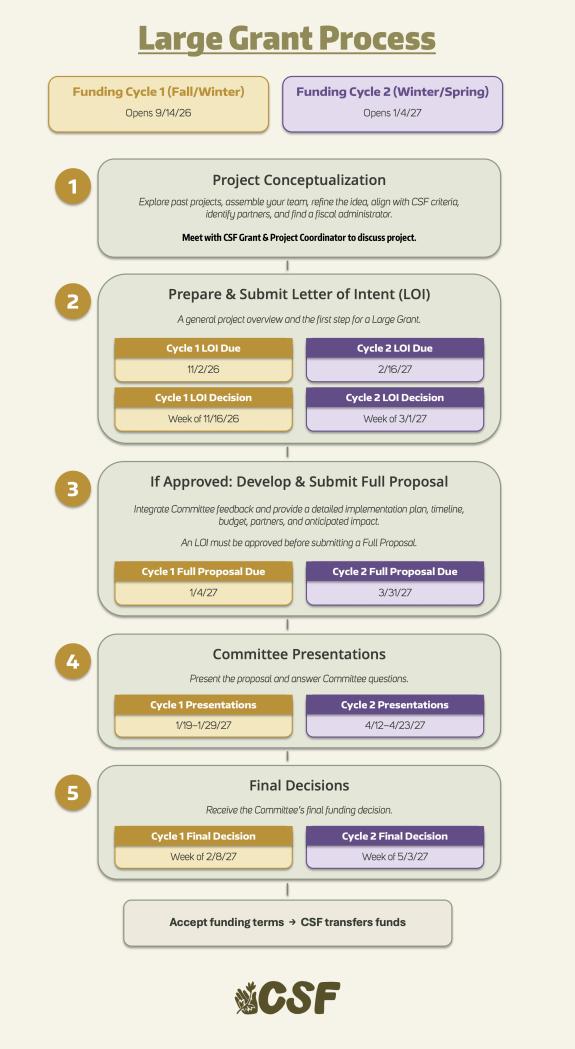
Large grants are for projects over $5,000 that typically require a longer implementation timeline, significant partner engagement, and collaboration across units. These projects have an extended impact on the UW campus. Explore past large grant projects (toggle type filter to "Large" and click apply).
Deadlines
There are two funding cycles per academic year. Each funding cycle consists of two stages: (i) Letters of Intent (LOI) and (ii) full project proposals.
Funding Cycle 1
- Opens: 9/14/26
- LOIs Due: 11/2/26
- LOI Decisions: Week of 11/16/26
- Full Proposal Due (if LOI approved): 1/4/27
- Presentations: 1/19–1/29/27
- Final Decisions: Week of 2/8/27
Funding Cycle 2
- Opens: 1/4/27
- LOIs Due: 2/16/27
- LOI Decisions: Week of 3/1/27
- Full Proposal Due (if LOI approved): 3/31/27
- Presentations: 4/12–4/23/27
- Final Decisions: Week of 5/3/27
Letter of Intent (LOI)
The LOI is the first step in applying for a large grant and gives a general overview of your proposed projects. LOIs are generally shorter than full project proposals. They serve as an initial step for the committee to evaluate project ideas, and give feedback. It should include:
- A summary of your project and how it meets CSF project criteria, including steps your team plans to take to increase feasibility by the Full Proposal stage (partner engagement, role development, budget research, etc.)
- Contact info for the core project team
- A basic estimated budget
- A fiscal admin who is able to support the project
- A basic timeline for project milestones and completion
The CSF core team reviews the LOI for completeness before passing it to the CSF Committee. Your LOI needs to be approved before you’re invited to submit a Full Proposal. Note that the Committee may request a feasibility study (see below) for large multi-year projects if deemed necessary.
Full Proposal
Integrate feedback from the CSF Committee into your Full Proposal. It should include:
- An executive summary
- Information on key partners
- Implementation plan and impact
- Detailed timeline and budget with fiscal admin approval
- Description of project longevity and community impact
Note that projects previously funded by CSF may be exempt from certain parts of the Full Proposal. More information will be provided in your LOI decision email on a case-by-case basis.
Partner engagement required at this stage:
- Fiscal Admin confirms they have reviewed and agrees to administer your final budget.
- Design Review Board, Engineering Services, and UW Facilities sign-off for any projects changing campus infrastructure (see Infrastructure section above).
- Project Approval and Support Form (PASF) gains explicit support from relevant partners on space, site, finances, or departmental endorsement. At least one written endorsement is required if your project is more involved than a one-time event. Multiple PASFs may be submitted.
Feasibility Studies
CSF requires large, multi-year infrastructure projects to conduct a feasibility study or submit a previously completed study with their application. Feasibility studies typically vet partner buy-in, project viability, location, design, logistics, and long-term sustainability. The cost of the study should not exceed 30% of expected full project costs.
Presentations
The Grant and Project Coordinator will contact you with next steps, including scheduling your presentation. You'll give a 5-minute presentation (mostly of photos and visuals) to the CSF Committee and participate in a 10 minute Q&A session. The Committee may request additional information before voting on approval and funding.
If approved, you'll meet with CSF staff for an orientation to review funding conditions and fiscal admin responsibilities. Then you're ready to begin! See the Managing your Grant page for more details.
Click on image do download a PDF version
Mini-grants are for projects up to $5,000, designed for ideas with a narrow scope that can be achieved on a shorter timeline. Explore past mini-grant projects (toggle type filter to "Small" and click apply).
Deadlines
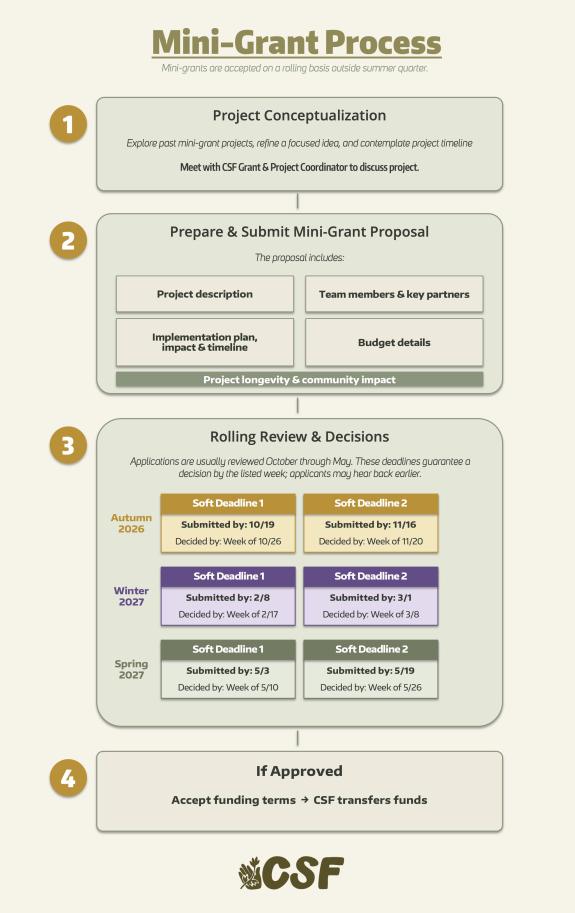
Mini-grants are evaluated on a rolling basis, usually October through May. To expedite decisions, we have set mid- and end-of-quarter deadlines that guarantee a decision by a designated date.You may hear back earlier depending on application volume.
Autumn 26
- Submitted by: 10/19 — Decided by: Week of 10/26
- Submitted by: 11/16 — Decided by: Week of 11/20
Winter 27
- Submitted by: 2/8 — Decided by: Week of 2/17
- Submitted by: 3/1 — Decided by: Week of 3/8
Spring 27
- Submitted by: 5/3 — Decided by: Week of 5/10
- Submitted by: 5/19 — Decided by: Week of 5/26
Applying
The mini-grant proposal includes:
- Project description
- Information on team members and key partners
- Implementation plan, impact, and project timeline
- Budget details
- Description of project longevity and community impact
Partner Engagement
- Acceptance of Administrative Responsibility (AAR): Demonstrates needed support from a budget or fiscal administrator. This is a required section in the application portal.
- Design Review Board, Engineering Services, and UW Facilities: Required for projects aiming to change campus infrastructure. Refer to the general section above for details and links.
- [Optional] Project Approval and Support Form (PASF): Gains explicit support from relevant partners on space, site, finances, or departmental endorsement. Multiple PASFs may be submitted.
After You Submit
The CSF Committee may request additional information via email. Please respond as soon as possible. Once all details are provided, the Committee will vote on approval and funding. If your project has an urgent timeline, please contact us.
If approved, you'll meet with CSF staff for an orientation to review funding conditions and fiscal admin responsibilities.Then you're ready to begin. See the Managing your Grant page for more details.
Click on image do download a PDF version
The Resilience & Compassion Seed Grant is a joint grant between the Resilience Lab and the Campus Sustainability Fund. The grant will open in the Spring of 2027.
Eligible Projects
Projects that align with the joint goals of the Resilience Lab and CSF will:
- Foster connectedness, belonging, and community across campus and beyond
- Cultivate kindness, compassion, and gratitude across human experiences
- Highlight connections between community, individuals, and sustainability
- Spark dialogue on environmental justice, social issues, and racial equity
- Center inherent human-ecological relationships and bridge perceived gaps between people and their environment
- Provide applied, actionable learning opportunities
Who Can Apply
Students, staff, and faculty, including administrative and academic units, on the tri-campuses are encouraged to apply.
Timeline
Applications open Monday, March 23, 2026, and close Sunday, April 26 at 11:59 p.m. Decisions will be announced at the end of May.
Application Materials
- Project Proposal including background and empirical justification, project description and goals, evaluation plan, and implementation timeline with key deliverables
- Detailed Budget Proposal with line-item budget and disclosure of any matching or additional funds
- [Optional] Letter of Support from an appropriate unit lead or faculty/staff advisor
Student leadership is not required but could strengthen your application.
Budget Guidelines
Funds cannot be used for:
- Expenses that solely benefit an individual rather than the community or project
- Retroactive funding for already-completed projects
- Items otherwise funded by the University or another source
- Stipends or salary for work done toward academic credit or graduation requirements
- Materials with limited use and high environmental burden (t-shirts, decorations, tote bags, excessive paper advertising, etc.) — though we are open to funding sustainable procurement of items already in the consumption cycle
Funds can be used for:
- Time and labor by UW faculty working outside regular duties
- Gift cards as compensation to research subjects or focus group participants (social security numbers must be collected per UW Tax Office policy)
- Food or drink as part of an activity or event
- Compensating students and non-faculty staff per Workday requirements and state/federal rules
Travel funding is not encouraged but will be considered on a case-by-case basis.
How Proposals Are Evaluated
A joint committee from the Resilience Lab and CSF will assess proposals based on alignment with resilience and compassion goals, quality and clarity of concept, community impact, feasibility, evaluation plan, and budget justification.
After You Submit
The joint Committee may request additional information via email — please respond as soon as possible. Once all details are provided, the Committee will vote on approval and funding. Need support before submitting? Schedule a meeting with the CSF Grant and Project Coordinator for feedback and guidance.
If approved, you'll receive an email with next steps, including funding conditions and fiscal admin responsibilities. See the Managing your Grant page for more details.
Project lead, please review this information and share it with your prospective fiscal admin. It is also recommended that you discuss your project budget spreadsheet for feedback before submitting — CSF staff are always available to answer fiscal admin questions directly.
Fiscal Setup
CSF uses stand-alone grant tags in Workday, so your unit must have the needed grant hierarchies in place (specifically Grant Security Hierarchy Level 4 Name & ID and Grant Financial Hierarchy Level 6 Name & ID). If your department needs to set up a stand-alone grant, submit a request in UW Finance Connect under Local Request and select Stand-Alone Grant.
Working with Students
Share a clear overview of your department’s budget process and keep a direct communication channel open with the project team, such as email, Teams, or Slack.
Fiscal Administrator Responsibilities
The fiscal administrator handles hiring actions, procurement, and payment processing in line with University and departmental policy. They also work with the project lead to enter, transfer, and reconcile expenses in UW fiscal systems.
Budget Control
CSF does not allow overspending, so expenses should be monitored regularly and kept within budget. Any overages must be covered by the project or department. If the project needs more funding or changes to budget line items, review the budget amendment and reallocation processes and get CSF approval.
Transfers and Closeout
Share the cost center and grant hierarchy information needed for CSF to create your grant tag. Transfers typically take up to three weeks. Once the project is set up, charge expenses directly to the project grant tag. If a project ends with a remaining balance, contact the CSF team to return unused funds to our Cost Center.