At a glance
The UW Burke Meadow team, comprising students, staff, and faculty, integrates Western agricultural practices with Indigenous… Read full summary
- Funding received
- 2025-2026
- Large
- Awarded
- $33,828
- Funding partners
-
- Services and Activities Fee (SAF)

The UW Burke Meadow team, comprising students, staff, and faculty, integrates Western agricultural practices with Indigenous ecological knowledge as part of the broader Native Food Ecosystem on campus. Originally focused on plant monitoring and maintenance, the project now includes educational programs, public work parties, arts collaborations, and partnerships with the UW Farm, horticultural greenhouses, and Wapato pond restoration. With over 1,500 volunteer hours logged and participation from more than a dozen students, the initiative fosters interdisciplinary learning, community engagement, and professional development. Continued support from the Campus Sustainability Fund expands the project’s impact, establishes an advisory board, and strengthens connections across the UW Native Food Ecosystem. Specifically, funds will be used for student and elder pay, and necessary plants/equipment for the meadow.
The team of students, staff, and faculty that comprise the Burke Meadow team are seeking to expand their work and impact as part of a broader network of spaces across campus that integrate Western Science agricultural practices and ecological knowledge with Indigenous science and knowledge. We define this network as the Native Food Ecosystem and are seeking continued support from the Campus Sustainability Fund for this expansion and the development of an advisory board to provide guidance and direction in this work.
Initially focused on plant community monitoring, maintenance, public work parties, and communications at the Burke Meadow the team has since expanded to include educational activities for UW courses and the public, arts-based collaborations, and integration with other campus initiatives such as the UW Farm Native garden and Wapato pond and seed collection and propagation with the horticultural greenhouses.
Our partnership with the Burke Museum, the College of Built Environments, and UW Grounds has deepened over time, and expanded to now involve students and faculty in Arts and Sciences, the College of the Environment, and the UW Farm. More than a dozen students have participated as hires or consistent volunteers, and we have logged more than 1,500 hours of volunteer efforts in maintenance and planting. Project members have presented at over ten conferences/meetings and in numerous courses.
This initiative continues to demonstrate the value of interdisciplinary collaboration and learning, producing meaningful benefits of the UW community, professional networks, and the public, guided by collective management and a shared commitment among all partners. As our project continues to grow and provide impact across the campus as part of the UW Native Food Ecosystem.
Ken Yocom
Project lead
- kyocom@uw.edu
- Affiliation
- Faculty
- Affiliated groups
- College of Built Environments
Eric Alipio
Team member
- ealipio@uw.edu
- Affiliation
- Student
- Years
- 2 year(s) remaining at UW
- Affiliated groups
- Department of Landscape Architecture, Burke Museum, UW Farm
Polly Olsen
Team member
- polly@uw.edu
- Affiliation
- Staff
- Affiliated groups
- Burke Museum
We submit this letter of intent on behalf of the students, staff, and faculty managing the Burke Meadow at the Burke Museum of Natural History and Culture, along with related collaborations at the UW Farm and the Burke Herbarium. Our work has been supported by the Campus Sustainability Fund (CSF #16-4546), Urban@UW, the Department of Landscape Architecture, the Burke Museum, and the Mellon Foundation.
Initially focused on plant community monitoring, maintenance, public work parties, and communications at the Burke Meadow, the project has expanded to include educational programming for UW courses and the public, arts-based collaborations, and integration with other campus initiatives such as the UW Farm Native Garden, Wapato Pond, and seed propagation in the horticultural greenhouses.
What began as a partnership between the Burke Museum, the College of Built Environments, and UW Grounds now involves students and faculty from Arts & Sciences, the College of the Environment, and UW Farm. More than a dozen students have participated as hires or consistent volunteers, and we have logged over 1,500 public/student volunteer hours in maintenance and planting over the years. Project members have presented at more than ten conferences and numerous courses.
This initiative continues to demonstrate the value of interdisciplinary collaboration, producing benefits for the UW community, professional networks, and the public, guided by collective management and a shared commitment among partners. As our work has grown across campus, we have come to identify the team and its work as the Native Food Ecosystem (NFE) at UW.
Renewed CSF funding will empower students to connect culture to land stewardship, develop environmental and cultural research skills, and host Indigenous cultural keepers as speakers and mentors. Our proposal sustains current paid student positions, creates new paid opportunities, supports (re)design of Indigenous cultural spaces on campus, and establishes a Native American advisory body to guide our future work.
Sustainable Impact
The 10,000-ft² Burke Meadow, created during the Burke Museum redevelopment, is a rare landscape type on campus. Once common in the region, camas meadows have largely disappeared due to agriculture and urban development, though Camassia spp. remains a vital food source with deep cultural significance to Indigenous communities across the Pacific Northwest.
The Meadow serves as the home base for the NFE. Located near a major campus entrance and the University District light rail station, it is visible to an estimated 25,000 students and employees daily. As part of the Burke’s living collections, the Meadow supports learning beyond the classroom and demonstrates how designed landscapes can connect ecological, cultural, and educational goals.
Because the Meadow requires specialized maintenance, UW Grounds initially expressed concern about its care. Our team has developed tailored management methods through an interdisciplinary, cross-cultural approach that ensures its continued health and educational value.
Collaborations with the Intellectual House and UW Farm have expanded our reach. At the UW Farm’s CUH location, we now steward both regionally specific cultural foods and Pan-Indian foodways through the Wapato Pond and Native Garden. Broader campus collaborations extend our sustainable impact through shared intellectual, material, and cultural resources.
Leadership & Student Involvement
Project oversight is coordinated by Polly Olsen, Steve Kryszko, and Ken Yocom, while students lead most weekly activities, including data collection, analysis, land stewardship, maintenance, event planning, and coordination with partners. Currently, five students (two graduate and three undergraduate) are employed hourly, each leading a specific project while supporting others. A student mentorship program enhances learning and organizational resilience.
Renewed CSF funding will enable two new stipend-based student positions and three stipend-based community cultural knowledge keeper positions. Together, these five roles will form a new advisory body facilitated by current team members. With approval of a 2025–2026 CSF Large Grant, the student roster would include seven paid students in the next academic year.
Education, Outreach, & Behavior Change
Education remains central to the project. CSF- and Mellon-supported students gain experience in project management, fieldwork, data analysis, and volunteer coordination. The team’s pedagogy emphasizes knowledge integration, interweaving Indigenous knowledge, Western science, and the creative arts. Faculty and students share this interdisciplinary approach through presentations to Burke patrons, UW classes, and professional conferences.
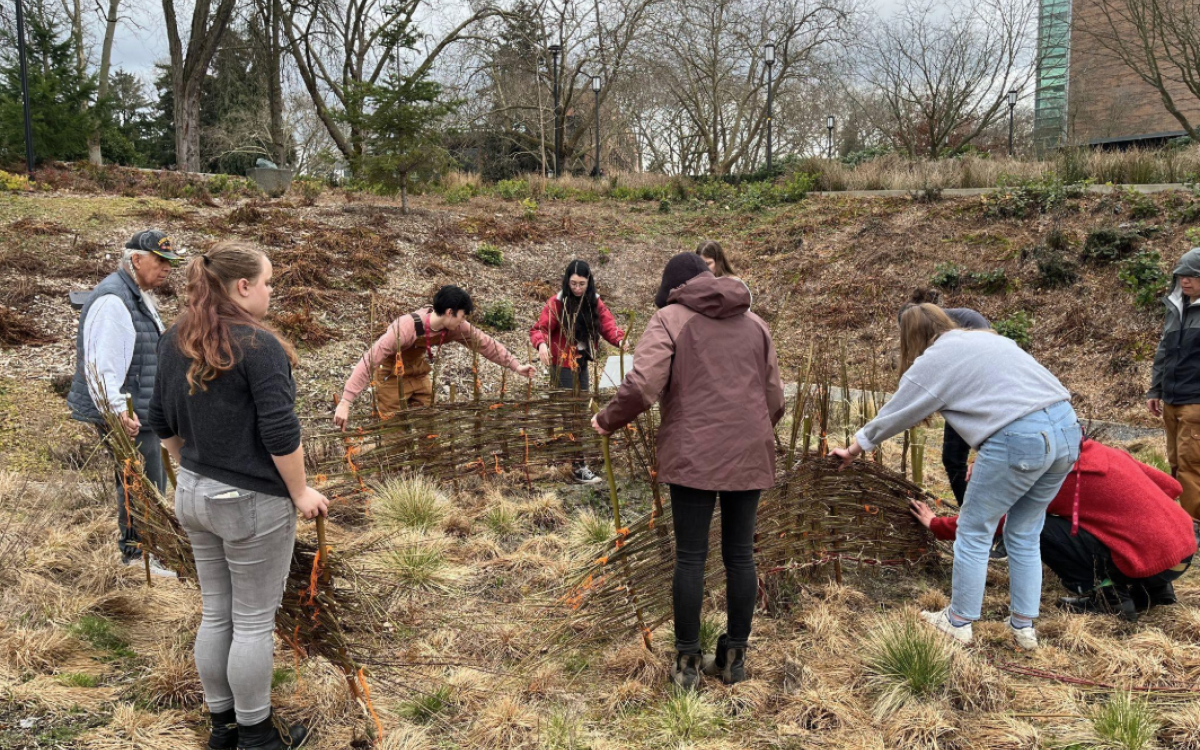
Regular volunteer work parties focus on meadow maintenance, drawing UW students and community members who have contributed hundreds of volunteer hours. Plants are sourced from local native nurseries such as Oxbow Farms and the Pacific Rim Institute. For four years, Oxbow staff have joined the team each autumn for a day-long maintenance event. To address rabbit grazing that reduces camas productivity, the team hosts annual workshops where local elders and master weavers teach students and volunteers to weave willow and alder branch baskets to “protect our food.” These handmade baskets are installed in the Meadow before each growing season. In winter 2024, the team conducted the first approved cultural burn on UW campus, introducing students and community members to traditional Indigenous land management while reinvigorating the Meadow soils for future growth.
As the project expands, we have identified the need for an advisory body to guide priorities and activities. Early discussions propose a council of three Native American Elders, one graduate student, and one undergraduate student, supported by two student administrative assistants and coordinated by team lead Polly Olsen. This advisory body will guide the entire NFE, encompassing both the Burke Meadow and UW Farm sites. By bringing Elders together with students, faculty, and staff, we aim to sustain Indigenous food knowledge and ensure that students continue to carry this learning forward through campus stewardship.
Feasibility & Accountability
Rooted in interdisciplinary, cross-cultural land stewardship, the NFE engages active campus and community participants deeply committed to strengthening environmental and cultural connections in an urban context. Volunteers and paid members alike have developed strong attachments to the Meadow and UW Farm projects, reflected in consistent engagement and continuity of effort.
Previous CSF funds have primarily supported student work and learning, with additional funds used to purchase supplemental plants. The Burke Museum and Department of Landscape Architecture have contributed funds for tools, gloves, and volunteer event supplies, while UW Grounds provides labor, truck access, and debris removal. With recurring volunteers, institutional funding, and logistical support from UW Grounds and UW Farm, the project maintains a robust network of accountability and investment across the University.
Over the past two years, the NFE has been supported by CSF and a Mellon Foundation grant, which enabled growth in activities, participation, and campus impact. As the Mellon grant concludes in the coming year, renewed CSF funding will sustain current paid student positions, establish the advisory body, and maintain project momentum until future external funds are secured. Continued CSF investment will ensure that the NFE remains a living example of how Indigenous ecological knowledge, community collaboration, and student leadership can guide sustainable land stewardship on the UW campus and beyond.
Steve Kryszko
Area Grounds Lead
- skryszko@uw.edu
- Affiliation and department
- UW Grounds
Perry Ackworth
Director
- persis@uw.edu
- Affiliation and department
- UW Farm
Request amount and budget
We are seeking $60,000 to support ongoing and expanding activities with the team. $45,000 will be to support our student employees for 9 months at 10 hours/week (approximated at $25/hr (salary + benefits). The additional $15,000 will be to support the establishment and compensation of the mixed student and broader community member advisory body. We will use the remainder of the funds from the previous CSF grant (materials, seeds, plants) and the Mellon Foundation (hosting materials and activities) to support direct costs for management materials and educational/hosting activities.
How the project will react to funding reductions
We recognize this is a large and ask and that funding is limited. If the proposal is determined to be fundable, but the full amount cannot be awarded we would adjust our expenditures. We first prioritize the funding for the advisory board to support their engagement, but would reduce the amount of money allotted to materials and then reduce the work hours/expectations for each student employed with the project to meet the allotted budget. These reductions are feasible to a point - beyond a roughly 40% reduction we would reduce student employees on the project.
Plans for financial longevity
Any and all budget is managed collaboratively with staff and faculty oversight. CSF funds are tagged for the College of Built Environment and used in accordance with University and CSF protocols. This is a long-term relationship that is well established and sustainable.
The timeline for this work is a 9-month period for the remainder of this academic year and into the next, excluding summer. We have been able to stretch past awards for longer periods due to supplementation from outside sources, and hope that the same will be true for this award, if accepted.
Student Team compensation = 9 months
Advisory Council = established by March 2026 with ongoing financial support for 1 calendar year.
Plans for long-term project management
The core of this project has been ongoing since 2020. Faculty and staff partners manage and mentor student leaders annually and plan for transitions with graduation. Additionally student leaders mentors others who join the project until they rise to leadership. The mentorship program is planned and structured to support leadership growth and evolves with the needs and interests of each student who joins the team.
Problem statement
Sustainable land management practices on the Seattle campus are at the core of the work our team has pursued over the past nearly 6 years. Beginning with the 10,000 sq. ft. meadow created as part of the Burke museum redevelopment we sought the opportunity to build greater knowledge for how distinct landscape types, such as a native meadow, could be managed, cared for and stewarded on campus. This work directly engages UW Grounds as partners to support their workflows and capacities while advancing care methods for supporting this unique community of plants on the Seattle campus. Through this work, we have advanced our own understanding of land management in many ways, particularly in connecting Western Science with Indigenous Science and Knowledge. We have developed systems and practices that provide a unique relationship between the land, the University, and the communities which engage with the space on a regular basis.
This growing relationship to the knowledge has extended into our own organizational structures and processes with the project. We lead the work with empathy and care for the meadow, ourselves, and one another. This has not only revealed success with the work, but established a sustainable community of committed and connected participants. We have had students, who upon graduating, have let us know how much the work and relationships with their peers, the staff, and the faculty meant to them in their learning journey at UW.
Through connection, empathy, and care, we are not only advancing the technical understanding of sustainable land management, but extending this into organizational structures and practices that extend the care for the land to the communities that care for it. For all of us, it has been a powerful experience which we are proud to be a part of.
Problem context
Building upon the 'problem statement' we are excited to extend this work and growing body of knowledge into the UW Native Food Ecosystem which is seeking partnerships with other organizations on campus, such as the UW Farm, with projects such as the Wapato pond, the native food garden, and the pit oven. These partnerships will enable our community to continue to expand while providing greater access for sharing indigenous foods, cultures, and traditions to a broader community in the UW and beyond.
As an organization we are prepared to take this step in supporting and engaging with others. Many of our student employees are already engaged in supporting these partners through volunteer activities. Yet, we recognize that for us to be able to grow our impact in this way we must do so in a thoughtful and considered way that prioritizes our relationships, supports our learning, and extends opportunities while minimizing any harm. The advisory board of 3 elders and 2 non-employed students will help guide our intentions and direct our work in ways to accomplish this.
Measure the impacts
| Impact / goal | Metric(s) of success | UW stakeholders impacted |
|---|---|---|
| Stewards campus landscape with sustainable practices | 100% native plant use with cultural importance | Undergraduate, Graduate, Academic staff, Admin staff |
| Educate students/public on the use of Western Science and Indigenous Knowledge in land management | Present work and methods to 300 people annually | Undergraduate, Graduate, Alumni, Admin staff |
| Volunteer Hours | Record 1000 hours of volunteer support annually | Undergraduate, Graduate, Alumni, Academic staff, Admin staff |
Education and outreach goals
Education is central to this project. Grant supported students gain direct experience in project management, fieldwork, data analysis, and volunteer coordination. They also learn through a practice of knowledge integration bridging Indigenous knowledge, Western science, and the creative arts which they, in turn, disseminate to others in formal presentations, trainings, and informal discussions. The team has presented to Burke patrons, hosted UW classes, and shared its work at national and local conferences. Our primary education goal is to explore the interdisciplinary practices necessary for land management when integrating Indigenous and Western science knowledge and practices. A secondary goal is to encourage students to see and understand the whole Seattle campus of UW as a learning environment -- not just what they get in classrooms. Its about learning with mind and body. Our hope with establishing an advisory board is that they can help us to more clearly articulate educational goals and opportunities as the management and care for these spaces continues to expand across campus.
Our project regularly utilizes existing communication (website and social media) platforms hosted by the Burke Museum of Natural History and Culture, the College of Built Environments, the Department of Landscape Architecture to publicize opportunities and events. As the work continues to expand we will look to gain opportunities to communicate through established platforms and networks with the UW Farm, the College of the Environment, and the College of Arts and Sciences. Further, the student team recently self-published a 'Zine which is a record of the learning while engaged with the project combined with a series of interviews with the project leaders. The hope is to continue to develop further editions of the 'Zine.
Student involvement
Project oversight is coordinated by Polly Olsen, Steve Kryszko, and Ken Yocom, while students lead most weekly activities—data collection, analysis, maintenance, activity planning, and collaboration coordination with partners. Currently 5 students (2 graduate and 3 undergraduate) are employed on an hourly basis to support these activities with each taking the lead on different projects while supporting others. We have established a student mentorship program with the students to support learning and increase the organizational resilience of the project.