At a glance
The First Nations at UW Spring Powwow is an annual, student-led gathering that brings together Native… Read full summary
- Funding received
- 2025-2026
- Large
- Awarded
- $10,543
- Funding partners
-
- Services and Activities Fee (SAF)
- Website & social links

Save the date poster for the 55th Annual Spring Powwow First Nations at UW.
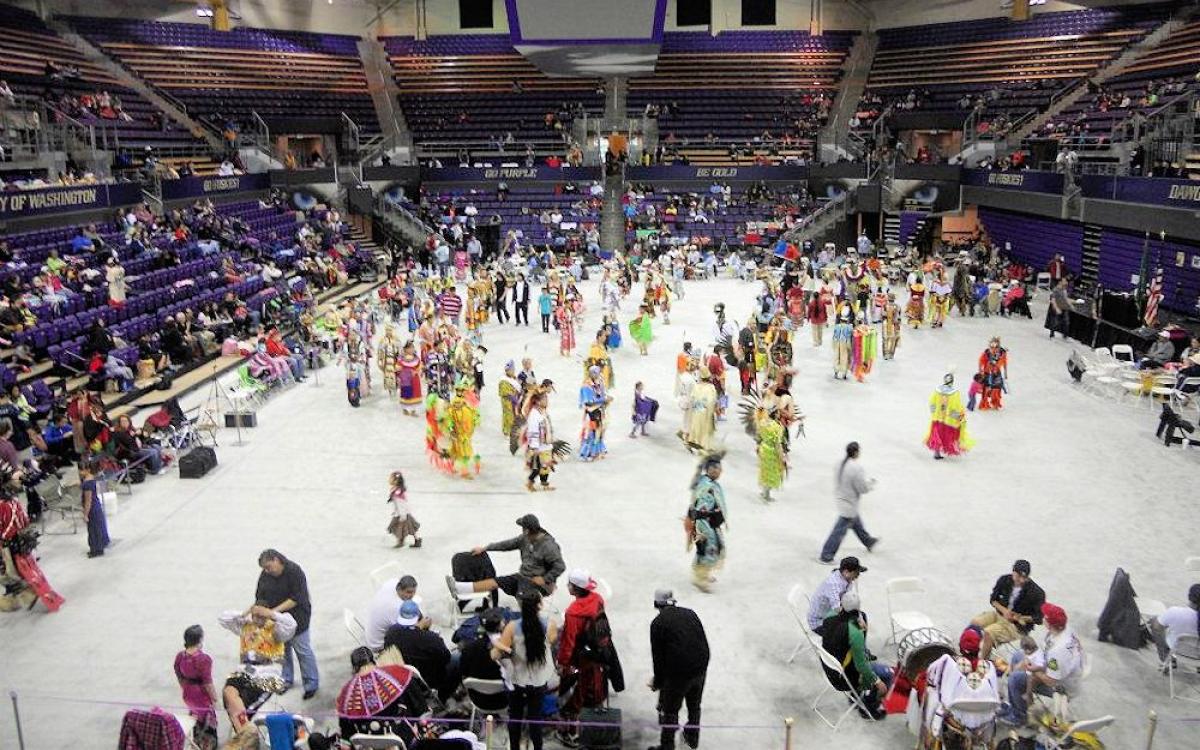
The First Nations at UW Spring Powwow is an annual, student-led gathering that brings together Native and non-Native students, community members, performers, and vendors to celebrate Indigenous cultures, traditions, and community. Hosted at Hec Edmundson Pavilion, the event features traditional singers, dancers, cultural vendors, educational activities, and opportunities to connect Native youth with higher education. The Powwow serves as a space for cultural preservation, community building, and intergenerational exchange while sharing Indigenous perspectives on relationships with the land and sustainable living. Environmental sustainability is incorporated through the use of compostable plates and utensils for concessions and educational programming that highlights Indigenous approaches to reciprocal relationships with the Earth. CSF funds are used to pay the kitchen supervisor, rental supplies for fry bread-making, as well as necessary event insurance.
Esteemed members of the Campus Sustainability Fund committee and staff:
Hello! We are a student-run organization designed to be inclusive and provide a culturally diverse experience to both Native and non-Native American members of the community while preserving our indigenous heritage. The club is the largest Native American student group on campus and seeks to provide opportunities to educate people on various tribes represented within our group and our experiences with the nations in our communities.
During the second weekend of April, First Nations hosts an Annual First Nations at UW Spring Powwow at Hec Edmundson Pavilion in Seattle, Washington. The event is open to the University, Native American community, and general public, and will invite local and visiting vendors to display their cultural designs and creations. The event will also host performers, both singers and dancers, from various parts of the Pacific Northwest, United States, and Canada. Our intent is to encourage Native American youth to pursue a post-secondary education. We hope students, faculty, and members of the surrounding communities will join us and delve into a wholesome, educational experience.
Social sustainability is central to Spring Powwow. It preserves not just a UW tradition, not just a local tradition, but more broadly, one that unites people of all tribes and cultures since time immemorial. Powwow encourages cultural exchange and engagement, welcoming all to partake in a celebration of life, tradition, and healing. We hope to re-establish the powwow as a mainstay once again at the University of Washington, for the benefit of not only indigenous students, but the entire UW population and associates.
In addition to the many culturally sustaining aspects of Spring Powwow, environmental sustainability is a key tenant as well. Native people have engaged and continue to engage with the land in a reciprocal way. Indigenous people have lived on these lands sustainably for thousands upon thousands of years. Colonization attempted to wipe that away, and keeping traditions like powwow alive is the key scaffolding to increasing sustainable living. Many of our speakers and activities center around the idea of living with the Earth’s and all living things longevity at the forefront of one’s mind.
We are asking for your support in the form of $20,000, to cover increases in facility expenses and carpet rental costs. The carpet is to cover the arena floor for the duration of the event. This is to provide safety and comfort for our dancers who will be performing traditional grass, fancy, and other dances. The CSF Grant will go towards this expense, which was quoted at $19167 in 2024, and a cost increase is expected. In the past we have reduced costs through collaboration with UW Gymnastics, but that wasn’t sustainable in the long term. Any help possible would go an extremely long way in ensuring that our powwow can continue to be a safe, educational, and sustainable space, that overall adds deep dimension to the University of Washington.
We also want to acknowledge that we serve all concessions using compostable plates and utensils. Additionally, we would love to include any and all material from CSF regarding sustainability in the physical powwow space. Concessions are our biggest profiter and contributor to keeping our powwow running in the long term and draw some of the most engagement at our powwow, so it is important to us that we do so sustainably.
Spring Powwow is a completely student-lead and student-organized event with support from First Nations at UW’s RSO advisor Alan Galvez and Assistant Director of the Kelly Ethnic Cultural Center, Nate Panelo. Our officer team is heavily reduced this year, and thus our powwow timeline is altered by the increased load that each member of our small team is bearing, completely voluntarily to ensure that our powwow still runs despite the difficulties.
Thank you for your time and consideration. We look forward to hearing from you regarding our Spring Powwow!
n/a
n/a
- user@example.com
- Affiliation and department
- n/a
- Stakeholder approval form
Request amount and budget
Our event budget is broken down into Facility rental costs, Staff Expenses, Honoraria, Equipment, and Supplies expenses. Our total budget overhead is estimated around $100,000 with the goal of First Nations to fund the almost event entirely through third party donations, grants, and sponsorships. This external sources include the UW Presidents External Affairs office granting $17,000 out of their budget, OMA&D pledging $30,000, and other on campus sources. The CSF grant would go towards our food equipment rental from CORT services (around $6,500) which supports our concessions, a Aramark kitchen supervisor as required by our contract to use Hec Edmundson Pavilion's kitchens (estimated around $1,200), and our event insurance (estimated at $850 based on last years costs). We have included invoices that we used to estimate these costs and our budget with this application.
How the project will react to funding reductions
For any potential budget cut that would eliminate the ability for the CSF grant to fulfill a budget item, we would increase our asks from the ECC or Intellectual House's approved funds for the projects. Both of these organizations work closely with First Nations on the Annual Powwow and have assured us in their ability to support the project if a reduction like that happens to occur.
Plans for financial longevity
N/A
Our event will include over 30 vendors and artists from around the country. Vendors will be confirmed through an application, which is open from January until space capacity is reached.
Our event is annual, and thus has created a streamlined timeline. Some committees begin work as early as September, depending on the availability and capacity of our personnel. In other years, most committees begin work in December or at the latest early January, including securing an artist for promotional materials in February, and headstaff (performers) contracts are sent out by March. A series of meetings with UW Athletics regarding logistics begins in Febuary though the date of the event in April.
The venue is secured at the beginning of the academic year, as we have an agreement with UW Athletics regarding our annual event. Advertising begins as early as December, while official promotions begin in March after we have an artist and artwork. The event is in April.
Plans for long-term project management
N/A
Problem statement
The powwow presented by First Nations at UW is a long standing tradition that has aimed to bring about visibility, collaboration, and support within the Native American community across all ages. the population of Indigenous students enrolled in higher education institutions remains very slim year after year. The needs for this small group of undergraduates, graduates, and staff goes unheard of every year at colleges and schools. large powwow such as the ones that we have hosted on campus before help to limit these struggles. These events connect elders in multiple tribes to young students and community members that are trying to find community and belonging. Through celebration, dance, stories, teachings, volunteering, and food, we provide a place of comfort and healing to take place. These values tie back to why our organization was founded in 1989. First Nation's mission is t o provide a community for Native American and Alaska Native students to help them succeed in higher education; to reach out to Native American and Alaska Native communities and help our youth continue on into higher education so that they may return and strengthen our Native nations; to bring awareness of Native peoples and issues to the University community; and to make alliance with non-Native student groups to pursue common goals.
Problem context
There is a large presence of affinity/legacy organizations and departments on campus that all operate in order to bring community and visibility to minority groups on campus. First Nations works directly with departments such as OMA&D, the Intellectual House, and the ECC consistently throughout academic years. These collaborations help us host student events, create resources for identifying students, shape campus policy, and increase outreach. This project fits into a larger group of opportunities for students, staff, and more to participate in the community. By collaborating with campus funds and grants, we are also putting committed funds to action towards inclusivity, awareness, and change.
Measure the impacts
| Impact / goal | Metric(s) of success | UW stakeholders impacted |
|---|---|---|
| Indigenous student representation | Over 4000 people in attendance | Undergraduate, Graduate, Alumni, Academic staff |
| Sustainable practices encouraged | Only using compostable/easily reusable supplies, and reaching a large audience | Undergraduate, Graduate, Alumni, Admin staff |
| Teach the community native culture | Host group with wide variety of age, ethnicity, and knowledge of indigenous culture | Undergraduate, Graduate, Alumni, Admin staff |
Education and outreach goals
The entire student body, including undergraduates and graduates, are encouraged to attend the annual powwow, no matter their self identification. We specifically target indigenous students and those in the AIS major since they will greatly benefit from the teachings at powwows and are usually already in the community surrounding it. We welcome other affinity RSOs to encourage their members to attend and participate, as there is a lot of networking within the ECC RSO circle. our goal is to share native culture and ideologies to those attending, especially during this time global need of healing and understanding. Our main way of sharing information with the public about the event is social media. First Nations has an instagram account that posts publicly about any upcoming meetings, events, resources, and more. It is our tradition to hire an artists each year to make our promotional poster which is shared to the instagram account. The poster is also put up around campus in hall pin boards, the ECC, Intellectual house, and other general public gathering spaces. We also have certain departments post the poster and share our links such as OMA&D on their socials. We plan on having details to the event linked in certain newsletters and websites that relate to First Nations, such as the ECC homepage and email list. On the day of the event we will have banners and tables outside of the stadium as well.
The Native student population at the University of Washington. Native students make up about 0.5% of the student body at the UW. There is no denying that Indigenous people are underrepresented even at diversity-rich institutions like UW, and events like powwow help create a safer environment for these students to express themselves. Powwows serve to bring communities together, celebrate culture, and make connections. At powwow, we include many high school students as volunteers to engage them with the University and encourage them to seek higher education. This is in the interest of the recruiting and admissions teams whose jobs center around promoting the education available at the University of Washington. In addition, these 100+ volunteers are made up of Native students at UW and local community members. Each year there are over 5000 attendees, and as our powwow becomes more advertised and consistent, these numbers are expected to increase. Funding events like powwow supports UW's ongoing mission to support diversity by combating the erasure of Indigenous people and creates an inclusive environment where Native youth feel safe.
Student involvement
First Nations strives to create a space for students to get involved. Due to this mission, we bring in about 100 volunteers from around campus for our spring powwow. Volunteers can sign up for diverse tasks and jobs and get to work closely with other FN officers to learn about the complexities of powwow. These volunteers range from members of Greek life, first nations members, and even alumni and various other UW students. Those involved in the powwow have continued support and mentorship from various on-campus resources. These resources include the Intellectual House and the Ethnic Cultural Center.
Powwow is an opportunity for many First Nations members to learn professional skills such as leadership, presenting, budgeting, grant writing and more. Students are encouraged to run for officer positions as well as take up committee chairs leading up to powwow. Some of these positions include, Finance chair, Art Committee Leader, Vendor Committee Leader, Outreach Chair, and many more. As a group of native students on campus, we prioritize giving ample support to all of our members. Whether it be giving opportunities to learn canoe pulling, how to speak in front of crowds or event plan and host events, powwow has many dedicated members and 10 officers who continue to put in work behind the scenes. Furthermore powwow is a space to make new connections, market and experience various different roles of leadership. Students in AIS classes, such as AIS 379 Powwow: Tradition and Innovation, typical are encouraged to participate in powwow as viewers or volunteers and have continued to help us share our culture with others.